
High-Performance Chemical-Resistant Piping Systems & Advanced Engineering Polymer Solutions
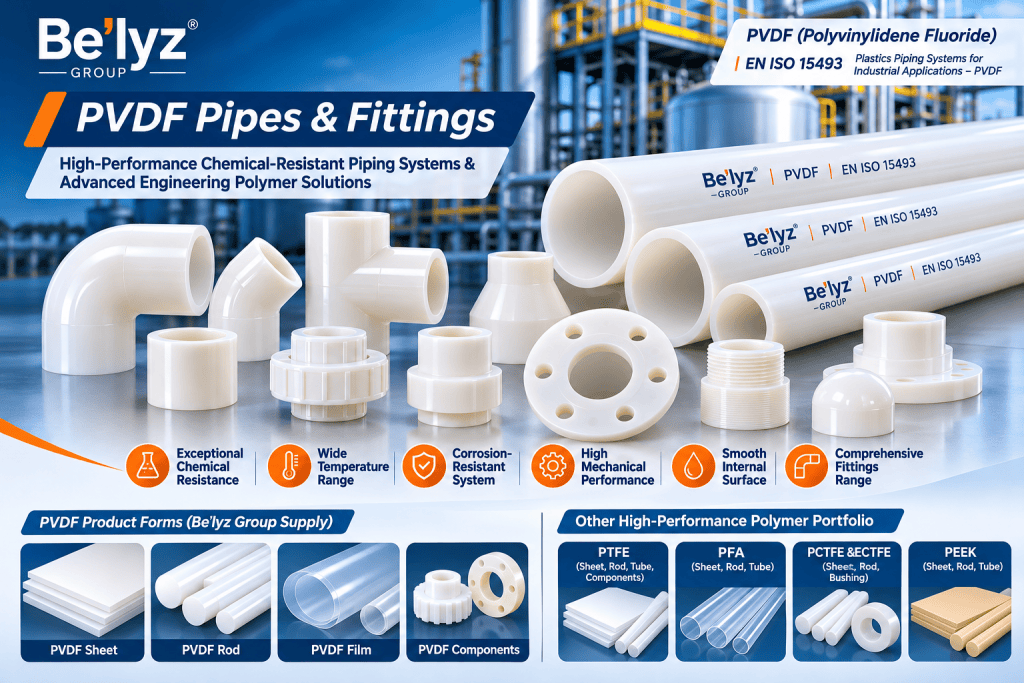
1. Product Overview
Be’lyz Group supplies PVDF (Polyvinylidene Fluoride) pipes, fittings and industrial piping components for demanding chemical processing, industrial fluid handling and corrosion-resistant piping applications worldwide.
PVDF is a high-performance thermoplastic fluoropolymer recognized for its exceptional resistance to a broad range of aggressive chemicals, making it a valuable material for piping systems operating in chemically demanding industrial environments.
Our primary product focus is on PVDF pipes and compatible fittings, providing international customers with access to piping solutions designed for chemical resistance, material integrity and reliable fluid conveyance.
Beyond piping systems, Be’lyz Group also offers PVDF sheets, rods, films and engineered components, together with a complementary portfolio of advanced fluoropolymers and engineering plastics.
1.1. Exceptional Chemical Resistance
Engineered for Aggressive Chemical Environments
Chemical resistance is one of the most important advantages of PVDF piping systems.
PVDF offers strong resistance to many inorganic acids, selected alkalis, oxidizing chemicals and other aggressive industrial media, depending on chemical concentration, operating temperature and service conditions.
This makes PVDF a suitable material for consideration in applications where conventional piping materials may experience chemical corrosion, degradation or reduced service life.
Key chemical-resistance characteristics include:
- Resistance to many aggressive acids: Suitable for consideration in chemical processing and acid-transfer applications, subject to chemical compatibility verification.
- Resistance to selected oxidizing chemicals: Applicable to certain oxidizing media under appropriately evaluated operating conditions.
- Corrosion-resistant thermoplastic construction: Eliminates electrochemical corrosion of the PVDF material itself.
- Chemical compatibility across industrial processes: Supports applications involving suitable chemical solutions and process fluids.
- Material stability: Provides a combination of chemical resistance and mechanical performance when operated within the selected product’s design limits.
Chemical compatibility must be evaluated for the exact chemical, concentration, temperature, pressure and exposure conditions. PVDF is not universally resistant to all chemicals, particularly certain strong alkaline media and organic solvents.
1.2. PVDF Pipes & Fittings — Primary Product Range
Be’lyz Group’s principal PVDF offering focuses on complete industrial piping requirements, including straight pipe sections and compatible connection components.
PVDF Pipes
PVDF pipes are used in suitable industrial fluid conveyance systems where chemical resistance, dimensional reliability and thermoplastic piping performance are important.
Available product configurations may include pressure-rated piping and other application-specific pipe constructions, depending on the selected manufacturer.
PVDF Pipe Fittings
Our sourcing portfolio includes compatible fitting configurations such as:
- 90° and 45° elbows.
- Equal and reducing tees.
- Concentric reducers and transition fittings.
- Couplings and socket fittings.
- Unions and detachable connections.
- Flange adaptors and flanged connections.
- End caps and closure fittings.
- Compatible joining and connection accessories.
Fitting availability, dimensional compatibility and joining methods depend on the selected piping system and manufacturer.
1.3. Key Material & System Characteristics
| Technical Characteristic | Product Description |
|---|---|
| Material | PVDF — Polyvinylidene Fluoride |
| Polymer Classification | High-performance thermoplastic fluoropolymer |
| Primary Product Range | Industrial pipes and compatible fittings |
| Principal Advantage | High chemical and corrosion resistance |
| Chemical Service | Suitable for many aggressive industrial media, subject to compatibility assessment |
| Thermal Performance | Suitable for selected elevated-temperature applications within product-specific operating limits |
| Mechanical Properties | Combination of strength, stiffness and toughness |
| Internal Pipe Surface | Smooth thermoplastic flow surface |
| Joining Options | Compatible thermoplastic welding and mechanical connection systems, according to product design |
| Pressure Classification | Manufacturer- and application-specific |
| Dimensional Selection | Outside diameter, wall thickness and applicable pipe series |
| Typical Applications | Chemical processing, industrial fluid handling, water treatment and suitable high-purity process systems |
| Technical Evaluation | Chemical compatibility, temperature, pressure, jointing and project requirements |
1.4. Additional PVDF Product Forms
In addition to pipes and fittings, Be’lyz Group supplies a broader range of PVDF semi-finished materials and engineered products.
PVDF Sheets
Flat thermoplastic sheets for suitable chemical-resistant fabrication, equipment construction, lining and industrial component applications.
PVDF Rods
Solid cylindrical stock materials intended for machining suitable industrial components and precision parts.
PVDF Films
Thin polymer films for selected protective, industrial and specialized applications, depending on the specific material grade.
PVDF Components
Fabricated or machined components for project-specific equipment and industrial applications.
These product forms complement our core PVDF piping portfolio and are supplied according to customer specifications and manufacturer availability.
1.5. Complementary High-Performance Polymer Portfolio
Be’lyz Group also supports the international sourcing of additional engineering polymers for industrial applications requiring specialized chemical, thermal, mechanical or dimensional properties.
| Material | Available Product Forms |
|---|---|
| PTFE — Polytetrafluoroethylene | Sheets, rods, tubes and engineered components |
| PFA — Perfluoroalkoxy Polymer | Sheets, rods and tubes |
| PCTFE — Polychlorotrifluoroethylene | Sheets, rods and bushings |
| ECTFE — Ethylene Chlorotrifluoroethylene | Sheets, rods and bushings |
| PEEK — Polyether Ether Ketone | Sheets, rods and tubes |
Each polymer has distinct material characteristics. Selection should be based on the actual chemical environment, operating temperature, mechanical requirements and intended application.
1.6. Industrial Applications
PVDF pipes and fittings may be specified for a variety of chemically demanding industrial applications, including:
- Chemical processing and chemical transfer systems.
- Industrial acid-handling installations.
- Chemical dosing and distribution networks.
- Industrial wastewater treatment facilities.
- Water treatment and selected high-purity fluid systems.
- Semiconductor and electronics process installations, where appropriate material grades and cleanliness requirements are satisfied.
- Pharmaceutical and specialty chemical processing, subject to applicable material and regulatory requirements.
- Corrosion-resistant piping installations in industrial facilities.
The suitability of PVDF for each application depends on the specific process conditions and selected product grade.
1.7. Be’lyz Group International Supply Capabilities
Be’lyz Group operates as an international sourcing and supply partner, supporting customers in identifying suitable PVDF piping systems and complementary engineering polymer products.
Our supply coordination focuses on:
- PVDF pipe and fitting requirements.
- Chemical compatibility and application-specific material selection.
- Dimensional and pressure-class specifications.
- Compatible jointing and connection components.
- Manufacturer technical documentation.
- Additional PVDF sheets, rods, films and engineered components.
- Complementary PTFE, PFA, PCTFE, ECTFE and PEEK product requirements.
- International procurement and shipment coordination.
Advanced Chemical Resistance. Engineered Piping Solutions. Global Material Supply.
Product availability, operating limits, dimensions, conformity documentation and technical performance are subject to confirmation for the selected manufacturer and material grade.
2. PVDF Pipes — Technical Specifications & Dimensional Series
Precision-Engineered Chemical-Resistant Piping for Industrial Fluid Handling
Be’lyz Group supports the international sourcing of PVDF (Polyvinylidene Fluoride) pipes for demanding industrial applications requiring high chemical resistance, reliable mechanical performance and compatibility with specialized thermoplastic piping systems.
PVDF piping systems are particularly valuable in chemical processing environments where resistance to aggressive media is a critical material-selection requirement.
Our supply portfolio focuses on industrial PVDF piping systems with project-specific dimensions, wall thicknesses, pressure classifications and compatible fittings.
2.1. PVDF Pipe Construction & Material Characteristics
PVDF pipes are manufactured from high-performance thermoplastic fluoropolymer materials and are available in configurations suitable for selected industrial pressure piping applications.
Their smooth internal surfaces and corrosion-resistant material construction support fluid conveyance in chemically demanding operating environments.
Key characteristics include:
- High Chemical Resistance: Resistance to a broad range of industrial chemicals, subject to chemical compatibility assessment.
- Corrosion-Resistant Construction: No electrochemical corrosion of the PVDF material itself.
- Smooth Internal Surface: Suitable for efficient fluid conveyance and selected process applications.
- Mechanical Performance: A combination of strength, stiffness and toughness within the specified operating limits.
- Thermal Capability: Suitability for selected elevated-temperature applications, depending on material grade and operating conditions.
- System Compatibility: Pipes and fittings can be selected for compatible thermoplastic joining and connection methods.
The actual material formulation, pipe dimensions and operating limits must be confirmed for the selected manufacturer and product system.
2.2. PVDF Pipe Dimensional Classification
Industrial PVDF pipes are commonly specified using nominal outside diameter, wall thickness and dimensional series.
| Technical Parameter | Description |
|---|---|
| Material | PVDF — Polyvinylidene Fluoride |
| Primary Application | Industrial chemical-resistant fluid handling |
| Nominal Diameter Designation | Outside diameter (OD), expressed in mm |
| Wall Thickness | Specified according to the applicable pipe series |
| SDR | Standard Dimension Ratio |
| SDR Definition | Nominal outside diameter divided by nominal wall thickness |
| Pressure Classification | Product- and manufacturer-specific |
| Principal Product Standard | EN ISO 15493, where applicable |
| Jointing | Compatible thermoplastic welding or approved mechanical connections |
| Technical Selection | Chemical compatibility, temperature, pressure, dimensions and joining requirements |
2.3. SDR — Standard Dimension Ratio
SDR is a dimensional relationship used to describe the ratio between a pipe’s nominal outside diameter and nominal wall thickness.
PVDF Pipes — Dimensional Reference
Polyvinylidene Fluoride · Chemical-Resistant Industrial Piping
The table below provides illustrative SDR geometry calculations for selected nominal outside diameters. Values are not a manufacturer’s dimensional catalogue and do not establish product availability, permissible wall thickness tolerances or pressure ratings.
| Nominal OD (mm) | SDR 21 Calculated e (mm) | SDR 17 Calculated e (mm) | SDR 11 Calculated e (mm) |
|---|---|---|---|
| 16 | 0.76 | 0.94 | 1.45 |
| 20 | 0.95 | 1.18 | 1.82 |
| 25 | 1.19 | 1.47 | 2.27 |
| 32 | 1.52 | 1.88 | 2.91 |
| 40 | 1.90 | 2.35 | 3.64 |
| 50 | 2.38 | 2.94 | 4.55 |
| 63 | 3.00 | 3.71 | 5.73 |
| 75 | 3.57 | 4.41 | 6.82 |
| 90 | 4.29 | 5.29 | 8.18 |
| 110 | 5.24 | 6.47 | 10.00 |
| 125 | 5.95 | 7.35 | 11.36 |
| 140 | 6.67 | 8.24 | 12.73 |
| 160 | 7.62 | 9.41 | 14.55 |
| 180 | 8.57 | 10.59 | 16.36 |
| 200 | 9.52 | 11.76 | 18.18 |
| 225 | 10.71 | 13.24 | 20.45 |
| 250 | 11.90 | 14.71 | 22.73 |
| 280 | 13.33 | 16.47 | 25.45 |
| 315 | 15.00 | 18.53 | 28.64 |
SDR = Nominal Outside Diameter / Nominal Wall Thickness
For pipes of the same outside diameter, a lower SDR generally indicates a greater wall thickness.
However, SDR alone does not establish the allowable operating pressure of a PVDF piping system.
Pressure capability depends on material properties, design criteria, operating temperature, chemical environment, intended service life and the relevant product standard.
2.4. Pressure & Temperature Considerations
PVDF piping systems may be used in selected pressure applications, provided the operating conditions are within the limits established for the actual pipe and fitting system.
Technical evaluation should include:
- Maximum and normal operating pressure.
- Operating and design temperatures.
- Chemical composition and concentration.
- Potential pressure surges or cyclic loading.
- Required service life.
- Pipe SDR and wall thickness.
- Fitting and joint pressure limitations.
- Manufacturer pressure-temperature derating guidance.
A nominal pressure rating stated at a reference temperature must not be assumed to remain unchanged at elevated operating temperatures.
2.5. Chemical Compatibility in Pipe Selection
Chemical resistance is a principal reason for selecting PVDF in industrial piping applications.
However, the chemical compatibility of a piping system must be evaluated for the complete assembly, not only the PVDF pipe material.
Assessment should consider:
- Pipe and fitting material grade.
- Chemical medium and concentration.
- Operating temperature and pressure.
- Elastomeric seals and gaskets, where applicable.
- Joining methods and associated components.
- Continuous or intermittent chemical exposure.
The selected piping system should be assessed against manufacturer chemical-resistance information and project-specific process conditions.
2.6. PVDF Pipe Technical Documentation
Depending on the selected supplier and project requirements, technical documentation may include:
- Pipe dimensional specifications.
- Available outside diameters and wall thicknesses.
- SDR or applicable pipe series.
- Pressure-temperature performance information.
- Material-grade identification.
- Chemical compatibility guidance.
- Compatible fitting and jointing information.
- Applicable conformity and testing documentation.
Be’lyz Group coordinates the sourcing of relevant manufacturer information to support technical evaluation and international procurement.
High Chemical Resistance. Reliable Industrial Piping. Project-Specific Technical Supply.
3. PVDF Pipe Fittings — Types, Dimensions & Connection Systems
High-Performance Chemical-Resistant Fittings for Industrial PVDF Piping Networks
Be’lyz Group supplies a comprehensive range of PVDF (Polyvinylidene Fluoride) pipe fittings and compatible connection components for demanding industrial fluid-handling applications.
PVDF fittings are designed to support the construction of chemically resistant piping networks, providing connections, changes in direction, branching arrangements and transitions between compatible pipe dimensions.
The selection of suitable fittings is essential to maintaining the chemical compatibility, mechanical integrity and operational reliability of the complete piping system.
3.1. PVDF Pipe Fittings Product Range
| Fitting Type | Product Description | Main Function |
|---|---|---|
| 90° Elbows | PVDF directional fittings for right-angle connections | Changes pipeline direction by 90° |
| 45° Elbows | PVDF directional fittings for angled connections | Changes pipeline direction by 45° |
| Equal Tees | Three-way fittings with compatible equal-size connections | Creates branch connections |
| Reducing Tees | Three-way fittings with a smaller branch connection | Connects different branch sizes |
| Concentric Reducers | Fittings for transitions between compatible pipe diameters | Reduces or increases nominal pipe size |
| Straight Couplings | Components for joining compatible straight pipe ends | Connects two pipe sections |
| Unions | Detachable connection fittings for suitable piping arrangements | Supports assembly and maintenance |
| Flange Adaptors | PVDF components for compatible flanged connections | Connects piping to equipment or flanged systems |
| End Caps | Closure fittings for compatible pipe ends | Terminates a piping section |
| Transition Fittings | Approved connection components between compatible systems | Supports specified system transitions |
Available fitting types, dimensions, pressure ratings and joining configurations depend on the selected manufacturer and PVDF piping system.
3.2. Chemical Resistance & System Integrity
Chemical compatibility must be maintained throughout the entire piping network.
PVDF fittings offer resistance to a broad range of aggressive industrial chemicals, making them suitable for consideration in chemical-processing applications where corrosion resistance is critical.
However, the overall chemical resistance of a piping system depends on every component exposed to the process medium.
Important considerations include:
- Chemical compatibility of the selected PVDF grade.
- Chemical concentration and operating temperature.
- Pressure and mechanical loading.
- Compatibility of seals, gaskets and other non-PVDF components.
- Joint design and installation quality.
- Exposure duration and operating conditions.
A chemically resistant PVDF pipe does not automatically guarantee the compatibility of every fitting, gasket or mechanical connection used in the system.
3.3. PVDF Fitting Dimensional Compatibility
PVDF fittings must be selected according to the dimensional specifications of the associated pipe system.
The following information is particularly important:
| Technical Parameter | Selection Requirement |
|---|---|
| Pipe Outside Diameter | Must match the relevant fitting connection dimension |
| Pipe Wall Thickness | Must be compatible with the selected joining system |
| SDR / Pipe Series | Must correspond to the approved pipe and fitting configuration |
| Fitting Geometry | Must meet the required connection and installation dimensions |
| Connection Type | Socket welding, butt welding or approved mechanical connection, as applicable |
| Pressure Capability | Must be suitable for the complete system’s design conditions |
| Material Grade | Must meet the specified chemical and thermal requirements |
| Applicable Standard | EN ISO 15493, where applicable to the selected system |
Fittings with identical nominal diameter designations are not necessarily interchangeable between different manufacturers or joining systems.
3.4. PVDF Pipe Joining Methods
Depending on the selected manufacturer, PVDF grade and piping configuration, compatible joining methods may include the following.
Socket Fusion Welding
A thermoplastic welding process used to join compatible PVDF pipe ends and socket fittings under controlled heating and assembly conditions.
Butt Fusion Welding
A welding method in which compatible pipe or fitting ends are heated and joined using specified temperature, pressure and alignment parameters.
Infrared Welding
A non-contact heating method used in certain specialized PVDF piping systems, including selected high-purity industrial applications.
Mechanical & Flanged Connections
Approved unions, flange adaptors and compatible sealing components may be used where detachable connections are required.
Joining procedures, welding parameters, equipment and operator requirements must follow the selected manufacturer’s instructions.
3.5. Pressure, Temperature & Joint Performance
The allowable operating conditions of a PVDF piping network depend on the performance of the complete assembly.
Technical assessment should include:
- Pipe and fitting pressure capability.
- Operating and design temperatures.
- Chemical exposure conditions.
- Jointing method and weld quality.
- Thermal expansion and movement.
- External mechanical loads.
- Equipment connection requirements.
- Manufacturer pressure-temperature limitations.
The allowable operating pressure of the complete piping system may be limited by its lowest-rated component.
3.6. PVDF Fittings for Industrial Applications
PVDF pipe fittings support a variety of industrial piping configurations, including:
- Chemical transfer and distribution lines.
- Industrial acid-handling networks.
- Chemical dosing installations.
- Water treatment process piping.
- Selected high-purity fluid systems.
- Corrosion-resistant equipment connections.
- Industrial process piping modifications and extensions.
Product selection must be based on the actual process medium, operating conditions and applicable project specifications.
3.7. International Supply of PVDF Pipes & Fittings
Be’lyz Group coordinates the international sourcing of PVDF pipes and compatible fittings to support project-specific industrial piping requirements.
Our supply coordination covers:
- PVDF pipe and fitting combinations.
- Elbows, tees, reducers, couplings and unions.
- Flange adaptors and connection accessories.
- Dimensional and jointing compatibility.
- Chemical-resistance requirements.
- Manufacturer technical documentation.
- International procurement and shipment coordination.
Complete PVDF Piping Solutions for Chemically Demanding Industrial Environments.
All fitting dimensions, connection configurations, pressure capabilities and technical documentation are subject to confirmation for the selected manufacturer and piping system.
PVDF Pipe Fittings — Technical Specifications
Chemical-resistant connections · Dimensional selection · EN ISO 15493 (where applicable)
| Fitting Type | Typical Configuration | Required Dimensional Parameters | Connection / Compatibility | Primary Function |
|---|---|---|---|---|
| 90° Elbow | Equal-end directional fitting | Pipe OD (d); end-to-centre dimension; socket depth or weld-end length | Socket / Butt Fusion* | 90° change of direction |
| 45° Elbow | Equal-end directional fitting | Pipe OD (d); end-to-centre dimension; socket depth or weld-end length | Socket / Butt Fusion* | 45° change of direction |
| Equal Tee | Three equal connection ends | Main and branch OD; overall length; branch centre height; end geometry | Socket / Butt Fusion* | Equal-diameter branch |
| Reducing Tee | Reduced branch connection | Main OD × branch OD; overall length; branch centre height | System-Specific* | Reduced-diameter branch |
| Reducer | Concentric or specified transition | Large OD × small OD; overall length; end geometry | System-Specific* | Diameter transition |
| Straight Coupling | Equal-size connector | Compatible pipe OD; coupling length; insertion depth | Socket Fusion* | Joining straight pipe sections |
| Union | Detachable connection | Pipe OD; overall length; connection-end dimensions; seal geometry | Mechanical / Socket* | Detachable joint for servicing |
| Flange Adaptor | Flanged transition assembly | Pipe OD; flange drilling pattern; bolt circle; face dimensions | Flanged* | Connection to equipment or flanged piping |
| End Cap | Pipe-end closure | Compatible pipe OD; cap depth; joining-end geometry | Socket / Butt Fusion* | Pipe termination |
| Transition Adaptor | System-specific transition | PVDF end OD; opposite-end specification; connection dimensions | Approved System* | Connection to another compatible system |
Dimensional Reference
Chemical Resistance & Material Performance
Advanced Chemical Resistance for Demanding Industrial Piping Applications
PVDF (Polyvinylidene Fluoride) is a high-performance fluoropolymer widely considered for industrial piping systems that require resistance to chemically aggressive process environments.
Its combination of chemical resistance, mechanical integrity and thermal performance makes PVDF an important material option for chemical transfer, industrial processing and specialized fluid-handling applications.
Be’lyz Group supplies PVDF pipes, fittings and complementary engineering polymer products through project-specific international sourcing.
Exceptional Chemical Resistance
Chemical resistance is one of the principal advantages of PVDF piping systems.
PVDF demonstrates strong resistance to many acids, oxidizing agents and other chemically aggressive media under suitable operating conditions.
Unlike metallic piping materials, PVDF does not undergo electrochemical corrosion. This characteristic can be particularly valuable in industrial environments where conventional metal components may be vulnerable to chemical attack.
However, PVDF is not universally compatible with every chemical. Certain strong alkaline environments, solvents and other aggressive substances may cause material degradation or unacceptable changes in performance.
Chemical compatibility must therefore be evaluated according to the actual substance, concentration, operating temperature, pressure and exposure duration.
Chemical Resistance by Media Category
| Chemical Media Category | General PVDF Material Considerations |
|---|---|
| Mineral Acids | Strong resistance to many mineral acids, subject to concentration and temperature |
| Organic Acids | Suitable for consideration with many organic acids; compatibility depends on the specific substance |
| Oxidizing Agents | Resistance to various oxidizing environments; individual media must be assessed |
| Alkaline Solutions | Compatibility limitations may apply, particularly with strong alkalis |
| Organic Solvents | Performance varies considerably by solvent; some solvents may attack or swell PVDF |
| Salts & Aqueous Solutions | Generally favorable resistance to many aqueous salt solutions |
| Industrial Chemical Mixtures | Requires evaluation of the complete chemical composition and operating conditions |
These descriptions are general material-selection guidance, not chemical compatibility approvals or guaranteed service ratings.
Temperature & Chemical Concentration
The chemical resistance of PVDF cannot be assessed independently of operating temperature.
An increase in temperature may change chemical compatibility, mechanical strength and allowable system pressure. Chemical concentration can also significantly influence material performance.
A piping system considered suitable for a particular chemical at one temperature or concentration may not be appropriate under more demanding conditions.
Technical selection should consider:
- Continuous and maximum operating temperatures.
- Chemical identity and concentration.
- Operating and design pressure.
- Continuous or intermittent exposure.
- Expected operating life.
- Manufacturer chemical compatibility guidance.
- Pipe, fitting, seal and joint performance.
Mechanical Strength & Pressure Performance
PVDF offers a useful combination of stiffness, strength and toughness for appropriately designed industrial piping systems.
Nevertheless, its allowable operating pressure depends on the selected material grade, pipe dimensions, SDR, operating temperature, chemical exposure and applicable design criteria.
Fittings and joints must also be evaluated as part of the complete system.
A pipe’s dimensional classification does not, by itself, establish its allowable operating pressure.
Corrosion Resistance & Internal Surface Characteristics
PVDF piping components are inherently resistant to electrochemical corrosion because they are manufactured from a non-metallic polymer material.
Their smooth internal surfaces can support efficient process-fluid conveyance and may help reduce certain surface-related operational issues compared with materials that undergo corrosion.
Actual hydraulic performance, fouling behavior and maintenance requirements depend on the conveyed medium and operating conditions.
Complete Piping System Compatibility
A PVDF piping installation must be evaluated as a complete assembly rather than as individual components.
System assessment should include:
- PVDF pipe and fitting grades.
- Welded or mechanical connection methods.
- Flange adaptors and compatible accessories.
- Gaskets and elastomeric seals.
- Valves and connected process equipment.
- Thermal expansion and mechanical support.
- Pressure-temperature operating limits.
A chemically resistant pipe does not automatically guarantee that all associated system components are suitable for the same process medium.
Applications in Chemically Demanding Industries
PVDF pipes and fittings are considered for selected applications in:
- Chemical manufacturing and processing.
- Industrial acid transfer and distribution.
- Chemical dosing and treatment systems.
- Industrial wastewater treatment.
- Corrosion-resistant process piping.
- Specialized fluid-handling installations.
- Selected high-purity processing systems, where the specified product grade and cleanliness requirements are met.
PVDF & Complementary Engineering Polymer Solutions
Beyond PVDF pipes and fittings, Be’lyz Group coordinates the supply of PVDF sheets, rods, films and engineered components.
Our broader engineering polymer portfolio also includes:
| Material | Available Product Forms |
|---|---|
| PVDF | Pipes, Fittings, Sheets, Rods, Films, Components |
| PTFE | Sheets, Rods, Tubes, Components |
| PFA | Sheets, Rods, Tubes |
| PCTFE | Sheets, Rods, Bushings |
| ECTFE | Sheets, Rods, Bushings |
| PEEK | Sheets, Rods, Tubes |
Each material has distinct chemical, thermal and mechanical characteristics. Selection should be based on the requirements of the specific industrial application rather than assuming equivalent performance across different polymers.
Be’lyz Group — Chemical-Resistant Polymer Supply
Be’lyz Group supports international procurement of PVDF pipes, fittings and advanced engineering polymer products for industrial projects.
We coordinate product sourcing, technical documentation and supply arrangements according to customer specifications and selected manufacturer capabilities.
High Chemical Resistance. Advanced Polymer Performance. Industrial Supply Solutions.
Final material selection and chemical compatibility must be confirmed using manufacturer documentation and the actual operating conditions.