
Ductile Iron & Grey Iron Covers | FRP / GRP Composite Manhole Covers | Access Frames | Gully Tops | Road & Linear Drainage Gratings
1. Product Overview
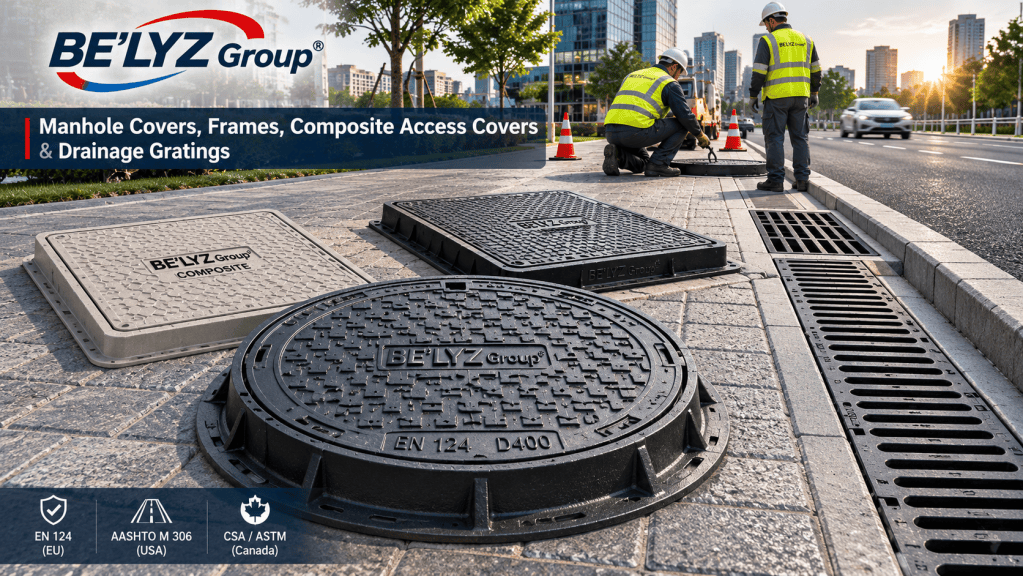
BE’LYZ Group supports international project-based sourcing of manhole covers, frames, composite access covers, gully tops and drainage gratings for municipal utilities, transportation corridors, telecommunications, water and wastewater networks, industrial facilities and commercial developments across European, United States and Canadian markets.
Our portfolio distinguishes structural access covers from hydraulic inlet gratings, and differentiates cast iron, ductile iron, fiber-reinforced polymer composites and unreinforced thermoplastic products. Products are selected against the applicable regional specification, complete assembly design, installation conditions and manufacturer-verified performance.
BE’LYZ Group acts as an international sourcing and supply coordination partner. Available sizes, load ratings, certifications, materials and custom markings must be confirmed by the selected manufacturer before an offer or compliance statement is finalized.
2. Product Range & Functional Classification
2.1. Ductile Iron Manhole Covers
Ductile (spheroidal graphite) iron covers for engineered access to sewer, stormwater, water, power and communications chambers. Available product designs may include round, square or rectangular covers, with compatible frames and specified retention features.
2.2. Grey Cast Iron Manhole Covers
Grey iron access covers for appropriate duty and approved municipal applications. Grey iron and ductile iron are not mechanically interchangeable; casting grade and assembly performance must be verified.
2.3. FRP / GRP Composite Manhole Covers
Fiber-reinforced polymer (FRP), often described as glass-reinforced plastic (GRP) when glass fiber is used, combines a polymer resin matrix with structural reinforcement.
Engineered composite covers may provide reduced mass and resistance to certain corrosive environments, depending on the formulation and design.
Each cover/frame assembly requires its own load, deflection, ageing, temperature and installation qualification.
2.4. Resin Composite / Polymer Concrete Access Covers
Selected composite systems may incorporate mineral-filled resin or polymer concrete construction.
These are distinct from glass-fiber-reinforced FRP covers and from plain PP/PE/PVC covers; their applicable standard part and verified performance must be established for the actual product.
2.5. Polymer Manhole Covers
Polypropylene, polyethylene and unplasticized PVC cover products, where offered, are a separate material family from reinforced composite products.
European EN 124-6 may be relevant to applicable products; do not label these as EN 124-5 composite covers without verification.
2.6. Manhole Frames & Complete Cover Assemblies
Matched frames and lids with approved bearing surfaces, clear openings, seating geometry and optional gaskets or locks.
Load qualification relates to the evaluated assembly and its intended installation.
2.7. Hinged, Lockable & Assisted-Opening Covers
Access solutions featuring hinges, security locks, retention systems or assisted opening where approved.
Mechanical integrity, user safety, maintainability and corrosion exposure must be assessed.
2.8. Recessed / Infill Access Covers
Covers designed to receive compatible paving or surface infill.
The completed assembly including infill must satisfy specified loads and service conditions.
2.9. Road Gully Tops & Drainage Gratings
Surface-water inlet assemblies comprising gratings and compatible frames, selected for traffic loading, slot geometry, debris management and hydraulic capture.
2.10. Linear Drainage Channels & Gratings
Channel drainage products and compatible grates for paved areas, industrial sites, parking areas and transport infrastructure.
System-level performance and applicable channel standards must be checked.
2.11. Heavy-Duty Industrial & Port Covers
Specially engineered covers for demanding traffic, handling equipment or industrial operations.
A nominal European load class alone does not establish suitability for unusual concentrated wheel, outrigger or impact loads.
2.12. Custom-Engineered & Branded Access Systems
Project-specific clear openings, surface patterns, locking arrangements, frame profiles and optional marking, subject to tooling feasibility and written manufacturer approval.
3. Materials, Manufacturing & Construction
3.1. Ductile Iron
Specified castings may use material grades assessed under EN 1563 in Europe or ASTM A536 in North America, when applicable.
Grade, microstructure, strength and casting quality must be documented.
3.2. Grey Iron
Relevant material specifications may include EN 1561 or ASTM A48/A48M, depending on market and product.
Grey iron is not assumed to match ductile iron impact or tensile behavior.
3.3. FRP / GRP Composite Construction
Composite covers may use glass or other fibers with thermoset resin systems, fillers, UV stabilizers and engineered reinforcement geometry.
Fiber architecture, resin chemistry, creep, fatigue, thermal performance, fire behavior and chemical compatibility require product-specific evidence.
3.4. Composite Manufacturing Methods
Potential processes include compression molding and other manufacturer-approved methods.
A production method does not itself establish a load class or certification.
3.5. Polymer Concrete and Unreinforced Polymers
Resin-bound aggregate systems and thermoplastic covers must be separately described and tested.
Do not apply reinforced-composite claims to unreinforced products.
3.6. Frames, Bearings, Seals & Fasteners
Frame material may differ from cover material.
Confirm seating dimensions, frame-to-cover fit, elastomeric seals, hinge/lock hardware, anchorage and corrosion exposure.
3.7. Surface Finish, Coatings & Identification
Surface patterns, slip characteristics, protective finishes, product marking and identification are governed by the selected product design and relevant specification.
4. Applications
4.1. Municipal Sewer & Stormwater Chambers
Inspection and maintenance access to drainage and sewer infrastructure.
4.2. Water Distribution & Utility Chambers
Access to valves, meters and utility structures subject to approved clearances.
4.3. Telecommunications & Fiber Networks
Access to communication vaults and cable distribution chambers; non-metallic covers may be considered where appropriate.
4.4. Roads, Streets & Kerbside Drainage
Traffic-rated cover assemblies and gully tops selected for exact placement and authority requirements.
4.5. Pedestrian, Commercial & Landscape Areas
Pedestrian access covers, architectural infill covers and drainage gratings suited to the location.
4.6. Industrial, Logistics & Port Facilities
Heavy-duty products evaluated for specific operational loads and maintenance access.
4.7. Coastal & Corrosive Environments
Composite and coated metallic systems may be evaluated for chemical and salt exposure; actual resistance is material- and design-specific.
4.8. Airports & Specialized Transportation Areas
Project-engineered assemblies with explicit authority approval and loading verification.
5. Key Product Advantages & Selection Benefits
5.1. Choice of Material Families
Ductile iron, grey iron, reinforced composite and selected polymer constructions enable application-specific selection.
5.2. Controlled Underground Access
Matched covers and frames provide access while supporting specified site safety requirements.
5.3. Composite Weight & Corrosion Considerations
Some qualified composite designs offer reduced handling mass and resistance to selected corrosive agents; performance must be demonstrated.
5.4. Traffic-Appropriate Engineering
Load selection considers road position, traffic, installation structure and relevant regional criteria.
5.5. Surface-Water Management
Gratings and inlets can collect runoff when appropriately sized and integrated into the drainage design.
5.6. Security & Operational Features
Optional locks, hinges, anti-lift features and seals may be selected as needed.
5.7. International Procurement Coordination
BE’LYZ Group aligns product requirements with applicable European, U.S. and Canadian procurement documentation.
6. International Standards & Regional Requirements
6.1. Europe — EN 124 Series
EN 124-1 provides general provisions for gully tops and manhole tops; the relevant material-specific part must also be identified:
- EN 124-2 — Cast iron
- EN 124-3 — Steel and aluminium
- EN 124-4 — Steel-reinforced concrete
- EN 124-5 — Composite materials
- EN 124-6 — PP, PE and PVC-U
Confirm scope and applicable edition.
6.2. Europe — EN 1433
EN 1433 applies to relevant drainage channel systems for pedestrian and vehicular areas; it is not a universal standard for all stand-alone gully gratings.
6.3. Europe — Casting Material Standards
EN 1563 may apply to spheroidal graphite cast irons and EN 1561 to grey cast irons, subject to specified grade.
6.4. United States — AASHTO M 306
AASHTO M 306 is a relevant U.S. procurement reference for drainage, sewer, utility and related castings where adopted by the contracting authority.
Applicability and the current project edition must be verified; it is not a blanket certification for composite covers.
6.5. United States — ASTM Casting Materials
ASTM A536 may be relevant to ductile iron castings and ASTM A48/A48M to grey iron castings.
Material conformity does not establish complete cover/frame traffic load compliance.
6.6. United States — Agency Drawings & Traffic Loading
State DOT, municipal and utility standards may govern casting geometry, frames, installation and traffic load requirements.
AASHTO highway loading terminology such as H-20/HS-20 must not be represented as automatically equivalent to EN 124 D400.
6.7. Canada — Provincial & Municipal Requirements
Canadian projects may reference provincial transportation ministry, city, municipal utility and owner-specific standard drawings and specifications.
Applicable CSA or ASTM standards must be confirmed per project; no single national manhole-cover rating is assumed.
6.8. Composite Products — Evidence Requirements
For composite products, identify the exact resin/reinforcement construction, applicable EN 124-5 scope if used, test reports, load/deflection and durability evidence.
For U.S. and Canadian projects, confirm acceptance under the owner’s composite-cover specification; do not infer compliance from European testing alone.
7. Quality Assurance, Documentation & International Supply
7.1. Material Traceability
Verify declared cast iron grade or composite resin/reinforcement construction and lot traceability as required.
7.2. Dimensional Inspection
Check clear opening, outside frame dimensions, depth, bearing and seating surfaces, lid fit and tolerances.
7.3. Mechanical Testing
Review load and deflection tests, residual deformation or other acceptance criteria under the applicable product specification.
7.4. Composite-Specific Verification
Assess creep, fatigue, environmental ageing, thermal behavior, chemical exposure and slip performance where required by the project.
7.5. Drainage Verification
Review grate geometry, inlet open area and project-specific hydraulic calculations; open area alone is not a certified inlet flow capacity.
7.6. Installation Documentation
Obtain approved installation drawings, concrete support requirements, bedding and anchorage details.
7.7. International Supply Coordination
BE’LYZ Group coordinates supplier confirmation, document exchange, packaging and international shipment for approved product configurations.
8. Detailed Technical Specifications & International Engineering Reference
The following tables are product-selection and procurement references, not manufacturer-specific dimensional schedules or certificates. Values presented as standardized class test loads are not permissible vehicle weights or guaranteed service loads.
8.1. Product Family & Regional Specification Matrix
| Product family | Europe — potential reference | United States — potential reference | Canada — selection basis |
|---|---|---|---|
| Ductile iron covers and frames | EN 124-1 + EN 124-2; EN 1563 material | AASHTO M 306 if adopted; ASTM A536 material; agency drawings | Province/municipality/utility specifications; applicable ASTM/CSA if stated |
| Grey iron covers and frames | EN 124-1 + EN 124-2; EN 1561 material | AASHTO M 306 if adopted; ASTM A48/A48M material | Local authority drawings and material requirements |
| FRP / GRP composite covers | EN 124-1 + EN 124-5 when in scope | Project/utility composite specifications and validated testing | Provincial, municipal or utility acceptance and composite testing |
| PP / PE / PVC-U covers | EN 124-1 + EN 124-6 when in scope | Project-specific product criteria | Owner-specific acceptance |
| Gully tops | EN 124-1 + relevant material part | Applicable casting specification and authority details | Local municipal/transportation details |
| Linear drainage channel systems | EN 1433 where applicable | Authority-approved channel and grate specifications | Provincial/municipal/owner channel system requirements |
Standard applicability depends on product scope, material, edition and contractual adoption. Do not assume cross-market certification.
8.2. European EN 124 Load Classes
| Class | Classification test load | Typical placement guidance (subject to standard) | Important limitation |
|---|---|---|---|
| A15 | 15 kN | Pedestrian and cycle-only locations | Not a general traffic rating |
| B125 | 125 kN | Footways, pedestrian areas and certain parking areas | Confirm actual placement and authority criteria |
| C250 | 250 kN | Specified kerbside/gully areas | Not a substitute for general carriageway D400 |
| D400 | 400 kN | Road carriageways and applicable vehicle-access areas | Not equivalent by definition to U.S. H-20/HS-20 |
| E600 | 600 kN | Areas subject to high wheel loads | Check project-specific wheel loads |
| F900 | 900 kN | Areas with particularly high wheel loads | Requires full system and site engineering |
kN values are standard classification test loads, not vehicle gross weight or allowable working loads.
8.3. North American Procurement & Load Terminology
| Reference or term | What it addresses | Use with care |
|---|---|---|
| AASHTO M 306 | Relevant U.S. casting procurement specification where adopted | Check current edition, product scope and purchaser modifications |
| ASTM A536 | Ductile iron casting material specification | Does not certify a complete cover assembly |
| ASTM A48/A48M | Grey iron casting material specification | Does not establish an installed load rating |
| H-20 / HS-20 | Historical highway design loading terminology used in certain project specifications | Not directly interchangeable with EN 124 test classes |
| State DOT / city standard drawings | Cover/frame dimensions, patterns, seating and installation | Often decisive for acceptance |
| Canadian province/city/utility specifications | Local casting schedules, traffic criteria and approved products | Verify the exact owner and jurisdiction |
8.4. Composite Cover Types — Critical Distinctions
| Type | Typical structural concept | Key verification | European reference where applicable |
|---|---|---|---|
| FRP / GRP reinforced composite | Fiber reinforcement in polymer resin matrix | Fiber/resin type, load and deflection, creep, UV, chemical exposure | EN 124-5 if within scope |
| Mineral-filled resin composite | Resin and mineral fillers; may include structural reinforcement | Exact composition, strength, fracture and ageing | Determine actual material-specific scope |
| Polymer concrete cover | Resin-bound aggregate construction | Structural testing, geometry, environmental performance | Determine actual material-specific scope |
| Unreinforced PP / PE / PVC-U | Thermoplastic construction without structural fiber reinforcement | Creep, impact, temperature, load testing | EN 124-6 if within scope |
Do not describe every non-metallic cover as GRP or as compliant with EN 124-5.
8.5. Composite Engineering & Durability Checklist
| Parameter | Required technical evidence | Why it matters |
|---|---|---|
| Resin system and reinforcement | Manufacturer material identification | Controls long-term structural and environmental behavior |
| Complete assembly mass | Measured lid + frame mass, separately stated | Handling and installation planning |
| Load and deflection | Applicable assembly test report | Confirms specified performance criterion |
| Creep under sustained load | Product-specific long-duration evidence if required | Polymers may deform over time |
| Fatigue / cyclic traffic | Relevant cycle test or engineering evidence | Repeated wheel loads |
| UV/weathering | Grade- and product-specific exposure evidence | Outdoor ageing |
| Thermal limits | Approved operating and installation range | Stiffness and dimensional change |
| Chemical resistance | Site-specific exposure assessment | Sewer gases, salts, fuels and cleaners |
| Slip resistance | Project-required surface testing | Pedestrian and vehicle safety |
| Fire and smoke properties | Only where required by the project | No blanket nonflammability claim |
| Metal detection / conductivity | Verified product properties if relevant | No blanket non-magnetic or radio-transparent claim |
8.6. Cover Dimensions & Clear Opening Data
| Dimension | Units | How to specify |
|---|---|---|
| Clear opening | mm / in | Actual unobstructed access aperture; not lid outside diameter |
| Cover outside diameter / length × width | mm / in | Manufacturer drawing |
| Frame outside diameter / length × width | mm / in | Civil opening interface |
| Frame depth / height | mm / in | Structural seat and pavement build-up |
| Lid thickness / profile | mm / in | Product-specific geometry |
| Bearing surface width | mm / in | Approved assembly design |
| Total assembly mass | kg / lb | Cover and frame separately where required |
| Seat/gasket profile | Drawing reference | Fit, noise and water-control criteria |
No universal nominal dimensions are claimed. Metric and U.S. customary units should be shown together on the approved drawings.
8.7. Cover & Frame Configurations
| Configuration | Typical use | Verification focus |
|---|---|---|
| Round cover + round frame | Utility access | Clear opening, frame seat, handling |
| Square/rectangular cover + frame | Vaults and service chambers | Corner stress, cover fit, access opening |
| Hinged cover | Frequent access | Hinge fatigue, retention and opening safety |
| Lockable cover | Restricted-access utilities | Security mechanism and maintainability |
| Gasketed/sealed cover | Odor or water-control objectives | Seal design and verified leakage performance |
| Recessed infill cover | Architectural paving | Completed infill weight and assembly strength |
| Composite cover with metallic frame | Mixed-material installation | Material interface, differential movement and corrosion |
8.8. Road Gully Tops & Drainage Gratings
| Parameter | Design question | Required input |
|---|---|---|
| Grating load class | Traffic and exact road position? | Owner-approved loading and installation category |
| Clear inlet opening | What unobstructed area is provided? | Grating drawing and dimensions |
| Bar/slot geometry | Pedestrian, cycle and debris risks? | Opening widths, orientation, safety requirements |
| Inlet hydraulic capacity | What runoff must be intercepted? | Design flow, slope, spread, inlet position |
| Frame support | How are loads transferred? | Concrete support and seating detail |
| Debris and maintenance | Expected clogging and cleaning access? | Site maintenance criteria |
8.9. Linear Drainage & Channel Gratings
| Component | Technical selection factor | Evidence required |
|---|---|---|
| Channel body | Material, depth, cross-section and support | Approved channel system drawings |
| Grate | Opening geometry and load classification | Matched system data and tests |
| Locking/retention | Traffic and maintenance requirements | Manufacturer connection detail |
| Outlet/end caps | Pipe connection and watertightness | Compatible system accessories |
| Hydraulic design | Longitudinal slope, contributing area and outfall | Project calculation and flow data |
| EN 1433 reference | Applicable European channel system scope | Complete system documentation where specified |
8.10. Hydraulic Drainage Design
| Input | Typical units | Design relevance |
|---|---|---|
| Contributing drainage area | m² / ft² | Runoff catchment |
| Design rainfall intensity | mm/h / in/h | Local storm design basis |
| Runoff coefficient | dimensionless | Surface response |
| Design discharge | L/s / cfs | Required conveyance |
| Longitudinal/cross slope | % | Inlet interception behavior |
| Grate effective opening | mm² / in² | One factor in capture capacity |
| Debris blockage allowance | project-defined | Operational performance |
| Downstream pipe/channel capacity | L/s / cfs | System bottleneck |
A grate open-area percentage alone is not a verified hydraulic capacity; site hydraulics and inlet interception must be engineered.
8.11. Material & Corrosion Comparison
| Material | Potential advantage | Limitations to verify |
|---|---|---|
| Ductile iron | High mechanical capability with appropriate design | Corrosion, coating, mass, casting grade |
| Grey iron | Established casting solutions for selected applications | Brittleness and product-specific load performance |
| FRP / GRP | Potential reduced mass and resistance to certain corrosion mechanisms | Creep, temperature, UV, fatigue, fire and resin compatibility |
| Polymer concrete / mineral composite | Potential chemical and surface performance benefits | Fracture, weight, exact composition and testing |
| PP/PE/PVC-U | Corrosion resistance for suitable designs | Temperature, creep, load limits, applicable standard |
8.12. Load Testing & Acceptance
| Test or review | Purpose | Required evidence |
|---|---|---|
| Load class test | Assess assembly resistance under specified method | Test report to applicable product standard |
| Deflection / residual deformation | Evaluate deformation behavior | Acceptance criteria and results |
| Cover/frame seating | Confirm compatibility and stability | Assembly inspection |
| Hinge/lock function | Assess retention and safe operation | Manufacturer test or inspection |
| Composite ageing/creep/fatigue | Evaluate long-term performance where required | Project-specific test evidence |
| Material grade confirmation | Identify casting/composite construction | Material certificate or manufacturer declaration |
| Grating hydraulic verification | Evaluate design inflow | Hydraulic calculation/test where specified |
8.13. Installation & Civil Engineering Requirements
| Installation topic | Design check | Responsible documentation |
|---|---|---|
| Chamber structure | Opening and support ring capacity | Civil design drawings |
| Concrete bedding/support | Bearing and load transfer | Owner-approved installation detail |
| Frame elevation | Flushness with finished surface | Site setting-out and inspection |
| Anchoring/retention | Movement and displacement control | Approved assembly detail |
| Traffic reinstatement | Pavement interface and curing | Construction method statement |
| Composite handling | Lift points, storage, UV/temperature constraints | Manufacturer instructions |
| Waterproofing/sealing | Leakage or odor performance where required | Specified gasket and test data |
8.14. Quality, Traceability & Documentation
| Document | Europe | United States / Canada |
|---|---|---|
| Product drawing | Clear opening, dimensions, assembly | Dimensioned drawing to owner requirements |
| Load test report | EN 124 relevant parts / EN 1433 where applicable | Applicable AASHTO/owner test criteria |
| Material documentation | EN 1561 / EN 1563 or composite formulation as applicable | ASTM A48/A48M / A536 or composite evidence as specified |
| Manufacturer marking | Relevant product and standard marking | Agency/utility identification where required |
| Installation guide | Assembly and bedding requirements | DOT/city/provincial details as applicable |
| Certificates / third-party reports | Only when actually issued and required | Only when actually issued and required |
8.15. Technical Procurement & Product Data Sheet
| Information required | Unit / format | Purpose |
|---|---|---|
| Destination country and authority | EU country / U.S. state / Canadian province | Identify applicable procurement rules |
| Product type and material | Ductile / grey / FRP / polymer concrete / thermoplastic | Correct product family |
| Standard and exact edition | EN / AASHTO / ASTM / owner drawing | Confirm test and acceptance basis |
| Requested class / design loading | EN class or owner-defined criteria | Avoid false cross-standard equivalence |
| Clear opening and frame dimensions | mm and in | Fit and civil compatibility |
| Installation location | Carriageway / kerb / sidewalk / industrial | Class and safety selection |
| Traffic and special loads | Wheel/axle/outrigger details where relevant | Engineering assessment |
| Locking, hinge and seal | Feature specification | Operational needs |
| Composite-specific requirements | Creep, UV, temperature, chemical and fire where relevant | Long-term suitability |
| Grate hydraulic criteria | Design flow, slope, opening constraints | Drainage selection |
| Marking and finish | Approved drawing/artwork | Brand/utility identification |
| Testing and documentation | Required reports and acceptance criteria | Procurement compliance |
| Quantity and destination | Units and shipping location | Logistics planning |
8.16. Regional Compliance & Equivalence Notice
EN 124 A15–F900 classification test loads, AASHTO highway design load terminology, AASHTO M 306 product requirements and individual Canadian authority criteria represent different technical frameworks. A product compliant with one framework must not be advertised as automatically compliant with another. Cross-market acceptance requires review of the exact product, testing, complete assembly and destination authority requirements.
8.17. Final Technical & Supply Notice
All technical content is intended for preliminary product identification and international procurement planning. Actual dimensions, load classes, safe-use conditions, composite formulation, hydraulic performance, certification status and manufacturer availability must be confirmed through current supplier documentation and approved project specifications. BE’LYZ Group supports sourcing and international supply coordination; final design, installation and acceptance remain with the authorized engineering and purchasing parties.