
1. Product Overview
High-Performance Polyethylene Piping Solutions for Water, Gas, Industrial and Infrastructure Applications
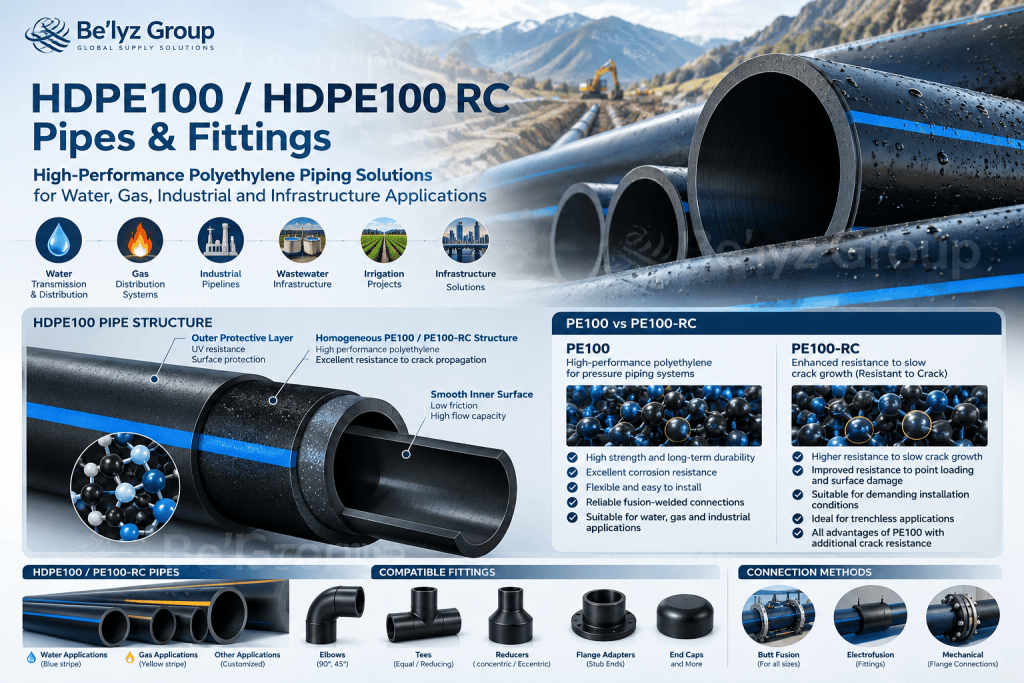
Be’lyz Group supplies high-performance HDPE PE100 and PE100-RC pipes and compatible fittings for potable water transmission and distribution, natural gas networks, industrial pipelines, wastewater infrastructure, agricultural irrigation and demanding underground installation projects.
Our product portfolio includes conventional PE100 pressure pipes and advanced PE100-RC piping systems engineered for enhanced resistance to slow crack growth, localized point loads and installation-related mechanical stresses.
PE100 and PE100-RC Material Performance
PE100 is a high-performance polyethylene material grade with a Minimum Required Strength (MRS) classification of 10 MPa, providing excellent corrosion resistance, flexibility, hydraulic performance and long-term reliability in pressure piping applications.
PE100-RC (Resistant to Crack) combines the established performance characteristics of PE100 with enhanced resistance to slow crack growth. This makes it particularly suitable for demanding installation methods, including horizontal directional drilling (HDD), pipe bursting and selected trenchless or reduced-bedding applications, subject to engineering assessment.
PE100-RC does not automatically provide a higher pressure rating than conventional PE100 pipes of the same diameter, SDR and design conditions.
PE100-RC Pipe Configurations — Type 1, Type 2 and Type 3
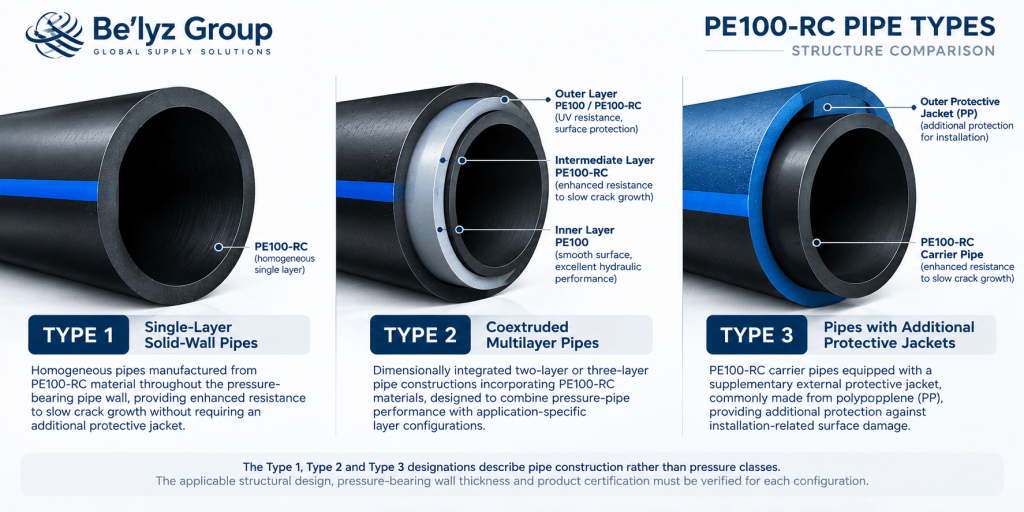
Be’lyz Group supports project-specific sourcing of PE100-RC pipes in three established construction configurations:
Type 1 — Single-Layer Solid-Wall PE100-RC Pipes
Homogeneous pipes manufactured from PE100-RC material throughout the pressure-bearing pipe wall, providing enhanced resistance to slow crack growth without requiring an additional protective jacket.
Type 2 — Coextruded Multilayer PE100-RC Pipes
Dimensionally integrated two-layer or three-layer pipe constructions incorporating PE100-RC materials, designed to combine pressure-pipe performance with application-specific layer configurations.
Type 3 — PE100-RC Pipes with Additional Protective Jackets
PE100-RC carrier pipes equipped with a supplementary external protective jacket, commonly made from polypropylene (PP), providing additional protection against installation-related surface damage.
The Type 1, Type 2 and Type 3 designations describe pipe construction rather than pressure classes. The applicable structural design, pressure-bearing wall thickness and product certification must be verified for each configuration.
International Standards & DIN CERTCO Certification
Depending on the intended application and product configuration, relevant technical references may include:
- EN 12201 / ISO 4427 — Polyethylene piping systems for water supply and applicable pressure drainage and sewerage applications.
- EN 1555 / ISO 4437 — Polyethylene piping systems for gaseous fuel supply.
- DIN 8074 / DIN 8075 — Polyethylene pipe dimensions and quality requirements, where applicable.
- DIN CERTCO PE100-RC Certification — Product-specific third-party certification under the relevant certification scheme.
- PAS 1075 — Historical technical reference associated with PE100-RC Type 1, Type 2 and Type 3 pipe construction classifications.
PAS 1075 has been withdrawn; current product conformity should be assessed against the applicable standards and valid certification requirements. DIN CERTCO certification must be confirmed for the specific manufacturer, product configuration and certificate scope.
Product Range & International Supply Solutions
Be’lyz Group coordinates the sourcing of PE100 and PE100-RC piping systems in various nominal outside diameters, SDR classifications, wall thicknesses and delivery configurations, subject to supplier capabilities and project specifications.
Compatible fittings may include butt-fusion fittings, electrofusion couplers, elbows, tees, reducers, flange adaptors and mechanical transition components.
Our international supply approach focuses on technical specification alignment, product traceability, material certification, quality documentation and coordinated procurement for infrastructure and industrial projects worldwide.
2. Product Range & Material Grades
Be’lyz Group supplies PE100 and PE100-RC polyethylene piping solutions for pressure and non-pressure applications, subject to the relevant product standards, supplier capabilities and project-specific requirements.
Our sourcing portfolio includes straight pipe lengths, coiled pipes where technically feasible, and compatible fittings for welded and mechanical connections.
2.1. PE100 — High-Performance Polyethylene Pipes
PE100 is a polyethylene material classification with a minimum required strength (MRS) of 10 MPa at 20°C over a 50-year reference period, determined through standardized long-term hydrostatic strength assessment.
PE100 piping systems offer excellent corrosion resistance, flexibility, low internal surface roughness and reliable fusion-welded joints.
Typical applications:
- Potable water transmission and distribution
- Natural gas distribution, where approved for the intended service
- Industrial process pipelines
- Irrigation and agricultural infrastructure
- Wastewater and pumping systems
2.2. PE100-RC — Enhanced Resistance to Slow Crack Growth
PE100-RC is a PE100 material with enhanced resistance to slow crack growth. This additional performance characteristic is particularly relevant for demanding installation environments.
Typical applications:
- Trenchless pipeline installation
- Horizontal directional drilling (HDD)
- Pipe bursting and rehabilitation projects
- Installations involving localized point loads
- Projects requiring enhanced resistance to surface damage and crack propagation
PE100-RC does not automatically provide a higher pressure rating than conventional PE100 of the same diameter, wall thickness and design conditions.
2.3. Available Pipe Configurations
Depending on the project and confirmed supplier capabilities, product configurations may include:
- Straight pipes in standard or project-specific lengths
- Coiled pipes for suitable nominal diameters
- Black pipes with application-specific identification stripes
- Solid-wall pipes for pressure pipeline systems
- Selected multilayer or protective-jacket pipe constructions
- Pipes supplied with compatible fusion or mechanical fittings
The exact diameter, SDR classification, wall thickness, pressure rating and delivery format must be confirmed against the applicable product standard and supplier documentation.
3. HDPE100 / PE100-RC Pipe Types & Fittings
Be’lyz Group provides a comprehensive sourcing portfolio of PE100 and PE100-RC pipes and compatible fittings for water transmission, gas distribution, industrial infrastructure, irrigation and demanding underground pipeline projects.
Our product solutions cover different pipe construction types, nominal outside diameters, SDR classifications, pressure requirements and joining systems, subject to applicable international standards and confirmed supplier capabilities.
PE100-RC Type 1, Type 2 and Type 3 pipe configurations are available for project-specific evaluation, with material performance, structural design and certification requirements assessed individually.
3.1. HDPE Pressure Pipe Product Range
Our HDPE pressure pipe sourcing range covers nominal outside diameters from DN/OD 20 mm to DN/OD 1600 mm, with multiple SDR and wall thickness configurations for project-specific requirements.
For nominal outside diameters between 20 mm and 110 mm, coiled pipe supply may be available depending on the pipe SDR, material properties, minimum bending radius and confirmed manufacturing capabilities. Larger diameters are generally supplied in straight lengths.
Product configurations may include conventional PE100 solid-wall pipes and PE100-RC Type 1, Type 2 and Type 3 systems, subject to technical suitability and supplier availability.
Custom pipe marking and private-label identification may be arranged subject to minimum order quantities (MOQ), manufacturer approval and project specifications.
Be’lyz Group also coordinates project-specific truck and container loading arrangements to optimize shipment utilization, with full-load commitments subject to confirmed loading calculations, transportation limits and order configuration.
The following dimensional and pressure reference table provides an overview of available design options and relevant technical considerations.
3.1.1. PE100 / PE100-RC Dimensional & Pressure Reference — DN/OD 20–1600 mm
Be’lyz Group supports project-based sourcing of PE100 and PE100-RC pressure pipes across a nominal outside diameter range of DN/OD 20 to 1600 mm, subject to confirmed manufacturer capabilities, applicable standards, available SDR combinations and project requirements.
DN/OD 20–1600 mmPE100 / PE100-RCType 1 / Type 2 / Type 3*SDR 11–26 reference
Reference Outside Diameters and Calculated Wall Thicknesses
The values below are indicative geometric wall thicknesses calculated as e = OD / SDR and rounded to 0.1 mm. They are not standardized nominal minimum wall thicknesses or a statement that every OD/SDR combination is manufactured or certified. Confirm the standard’s dimensional series, tolerances and minimum wall thickness from the product data sheet before ordering.
| DN/OD (mm) | SDR 11 e ≈ mm | SDR 13.6 e ≈ mm | SDR 17 e ≈ mm | SDR 21 e ≈ mm | SDR 26 e ≈ mm | Delivery option |
|---|---|---|---|---|---|---|
| 20 | 1.8 | 1.5 | 1.2 | — | — | Coils possible* / Straight lengths |
| 25 | 2.3 | 1.8 | 1.5 | 1.2 | — | Coils possible* / Straight lengths |
| 32 | 2.9 | 2.4 | 1.9 | 1.5 | 1.2 | Coils possible* / Straight lengths |
| 40 | 3.6 | 2.9 | 2.4 | 1.9 | 1.5 | Coils possible* / Straight lengths |
| 50 | 4.5 | 3.7 | 2.9 | 2.4 | 1.9 | Coils possible* / Straight lengths |
| 63 | 5.7 | 4.6 | 3.7 | 3.0 | 2.4 | Coils possible* / Straight lengths |
| 75 | 6.8 | 5.5 | 4.4 | 3.6 | 2.9 | Coils possible* / Straight lengths |
| 90 | 8.2 | 6.6 | 5.3 | 4.3 | 3.5 | Coils possible* / Straight lengths |
| 110 | 10.0 | 8.1 | 6.5 | 5.2 | 4.2 | Coils possible* / Straight lengths |
| 125 | 11.4 | 9.2 | 7.4 | 6.0 | 4.8 | Straight lengths |
| 140 | 12.7 | 10.3 | 8.2 | 6.7 | 5.4 | Straight lengths |
| 160 | 14.5 | 11.8 | 9.4 | 7.6 | 6.2 | Straight lengths |
| 180 | 16.4 | 13.2 | 10.6 | 8.6 | 6.9 | Straight lengths |
| 200 | 18.2 | 14.7 | 11.8 | 9.5 | 7.7 | Straight lengths |
| 225 | 20.5 | 16.5 | 13.2 | 10.7 | 8.7 | Straight lengths |
| 250 | 22.7 | 18.4 | 14.7 | 11.9 | 9.6 | Straight lengths |
| 280 | 25.5 | 20.6 | 16.5 | 13.3 | 10.8 | Straight lengths |
| 315 | 28.6 | 23.2 | 18.5 | 15.0 | 12.1 | Straight lengths |
| 355 | 32.3 | 26.1 | 20.9 | 16.9 | 13.7 | Straight lengths |
| 400 | 36.4 | 29.4 | 23.5 | 19.0 | 15.4 | Straight lengths |
| 450 | 40.9 | 33.1 | 26.5 | 21.4 | 17.3 | Straight lengths |
| 500 | 45.5 | 36.8 | 29.4 | 23.8 | 19.2 | Straight lengths |
| 560 | 50.9 | 41.2 | 32.9 | 26.7 | 21.5 | Straight lengths |
| 630 | 57.3 | 46.3 | 37.1 | 30.0 | 24.2 | Straight lengths |
| 710 | 64.5 | 52.2 | 41.8 | 33.8 | 27.3 | Straight lengths |
| 800 | 72.7 | 58.8 | 47.1 | 38.1 | 30.8 | Straight lengths |
| 900 | 81.8 | 66.2 | 52.9 | 42.9 | 34.6 | Straight lengths |
| 1000 | 90.9 | 73.5 | 58.8 | 47.6 | 38.5 | Straight lengths |
| 1100 | 100.0 | 80.9 | 64.7 | 52.4 | 42.3 | Straight lengths |
| 1200 | 109.1 | 88.2 | 70.6 | 57.1 | 46.2 | Straight lengths |
| 1400 | 127.3 | 102.9 | 82.4 | 66.7 | 53.8 | Straight lengths |
| 1600 | 145.5 | 117.6 | 94.1 | 76.2 | 61.5 | Straight lengths |
Indicative Pressure Class Reference — PE100 at 20°C
| SDR | Typical water PN reference | Basis | Important limitation |
|---|---|---|---|
| SDR 11 | PN16 | PE100, MRS 10 MPa, C = 1.25, 20°C | Subject to applicable standard, application and design verification |
| SDR 13.6 | PN12.5 | PE100, MRS 10 MPa, C = 1.25, 20°C | Subject to applicable standard, application and design verification |
| SDR 17 | PN10 | PE100, MRS 10 MPa, C = 1.25, 20°C | Subject to applicable standard, application and design verification |
| SDR 21 | PN8 | PE100, MRS 10 MPa, C = 1.25, 20°C | Subject to applicable standard, application and design verification |
| SDR 26 | PN6.3 | PE100, MRS 10 MPa, C = 1.25, 20°C | Subject to applicable standard, application and design verification |
Material, Construction and Standards
| Reference | Scope / relevance | Procurement requirement |
|---|---|---|
| EN 12201 | PE piping systems for water supply and pressure drainage / sewerage | Confirm applicable part, edition, dimensions and product conformity |
| ISO 4427 | PE piping systems for water supply and pressure drainage / sewerage | Confirm applicable part, edition and intended service |
| EN 1555 | PE piping systems for gaseous fuels | Confirm gas-approved compound, fittings, joining and MOP design |
| ISO 4437 | PE piping systems for gaseous fuels | Confirm applicable part and gas-specific approvals |
| DIN CERTCO | Third-party certification organization / applicable certification scheme | Verify valid certificate, manufacturer, product type, dimensions and scope |
| PAS 1075 (withdrawn) | Historical reference for PE100-RC Type 1, Type 2 and Type 3 construction | Do not present as a current product certification; verify current requirements |
Construction types: Type 1 = homogeneous PE100-RC solid wall; Type 2 = dimensionally integrated coextruded multilayer construction; Type 3 = PE100-RC carrier pipe with a separate additional protective jacket. These are construction types, not pressure classes. Type 2/3 availability and certification must be confirmed individually.
Custom Marking, Order Quantities & Optimized Loading
- Private labeling / custom pipe marking: Available upon request, subject to minimum order quantity (MOQ), manufacturing approval, marking regulations and confirmed production arrangements.
- Project-specific loading: Truck and container loading plans can be optimized for pipe OD, SDR, length, nesting suitability, protective packaging, payload and route constraints.
- Full-load supply planning: Be’lyz Group aims to arrange full truckload (FTL) or full container load (FCL) shipments for qualifying orders. A full-load commitment is confirmed per order only after final loading engineering, available cargo quantity, equipment selection and legal weight / dimensional checks.
- Order confirmation: Final availability, diameter/SDR combinations, coil format, pipe length, markings, applicable certificates and loading plan are agreed in the commercial and technical offer.
All figures and configurations are technical references for enquiry preparation. No manufacturer-specific production capacity, third-party certification or universal availability is implied.
3.2. Advanced Quality Assurance & End-to-End Material Traceability
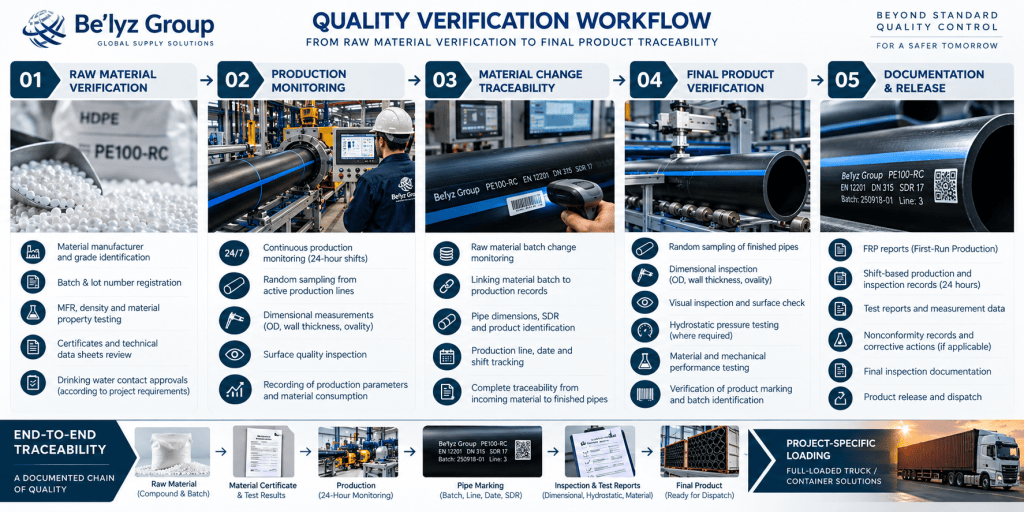
Beyond Standard Quality Control — From Raw Material Verification to Final Product Traceability
At Be’lyz Group, quality assurance begins before pipe production and continues throughout the manufacturing process until final product verification and documentation.
Our project-specific quality assurance approach is designed to go beyond conventional final-product inspection by coordinating raw material verification, production-stage testing, random sampling, continuous dimensional monitoring and comprehensive traceability documentation.
This approach is particularly important for potable water infrastructure, where material conformity, product safety and documented traceability are essential.
3.2.1. Pre-Production Raw Material Verification
Before manufacturing begins, the designated polyethylene raw material is subject to verification against the approved project specifications and applicable technical requirements.
Depending on the project, verification activities may include:
- Raw material manufacturer and grade identification.
- PE100 / PE100-RC compound classification verification.
- Raw material batch and lot number registration.
- Review of raw material certificates and technical data sheets.
- Melt mass-flow rate (MFR) verification, where specified.
- Density and relevant material property testing.
- Review of applicable drinking-water contact approvals.
Production authorization is coordinated only after the required material documentation and verification results have been reviewed against the agreed acceptance criteria.
3.2.2. In-Process Quality Control & Random Sampling
Once production begins, representative pipe samples are selected at defined intervals or according to the approved inspection and test plan.
Quality control activities may include:
- Random sampling from active production lines.
- Outside diameter and wall thickness measurements.
- Ovality and dimensional tolerance verification.
- Visual inspection and surface quality assessment.
- Relevant material and mechanical performance testing.
- Monitoring of production parameters and material consumption.
Sampling frequency, test methods and acceptance criteria are established according to the applicable standards and project-specific quality requirements.
3.2.3. Continuous Material Change Monitoring & Batch Traceability
Material traceability is maintained throughout the production process, including situations where a raw material batch or lot changes during manufacturing.
The traceability system is designed to link:
- Raw material supplier and compound grade.
- Raw material batch and lot identification.
- Production line and manufacturing date.
- Production shift and relevant time records.
- Pipe dimensions, SDR and product identification.
- Inspection results and test reports.
- Finished-product batches and dispatch documentation.
Where raw material changes occur during production, the corresponding transition records and product identification are documented to support traceability between incoming materials and finished pipes.
3.2.4. 24-Hour Shift-Based Production & Inspection Reporting
For projects requiring continuous production monitoring, Be’lyz Group coordinates the collection and review of shift-based manufacturing and inspection documentation.
These records may include:
- First-run production (FRP) reports, where required by the agreed project documentation system.
- Production records covering 24-hour operating cycles.
- Shift-based dimensional measurement reports.
- Raw material consumption and batch-change records.
- Random sample identification and test results.
- Nonconformity records and corrective actions, where applicable.
This documentation supports production transparency, dimensional consistency, material traceability and the timely identification of deviations from approved project requirements.
3.2.5. Final Product Testing & Independent Verification
Following production, randomly selected finished pipes are subject to final inspection and testing in accordance with the approved Inspection and Test Plan (ITP), applicable product standards and customer specifications.
Verification activities may include:
- Final outside diameter, wall thickness and ovality measurements.
- Visual inspection and surface condition assessment.
- Hydrostatic pressure testing, where required by the applicable standard or project specification.
- Material property and mechanical performance testing.
- Verification of product marking, batch identification and traceability records.
- Review of production-stage inspection reports and final test documentation.
Where specified, independent third-party inspection and accredited laboratory testing may be coordinated.
Final product acceptance is supported by the relevant inspection records, test reports, material documentation and conformity evidence.
3.2.6. Potable Water Applications — Traceability from Raw Material to Finished Pipe
For piping systems intended for potable water transmission and distribution, Be’lyz Group places particular emphasis on raw material identification, drinking-water contact compliance and end-to-end production traceability.
Our project-specific quality assurance approach is designed to establish a verifiable documentation chain connecting:
- Approved polyethylene compound manufacturers and material grades.
- Raw material certificates, batch numbers and incoming verification results.
- Production lines, manufacturing dates
4. Applications of HDPE100 / PE100-RC Piping Systems
Reliable Polyethylene Piping Solutions for Critical Infrastructure
Be’lyz Group supports the international supply of PE100 and PE100-RC piping systems for a wide range of infrastructure, industrial and utility applications.
Our project-based sourcing approach considers operating conditions, installation methods, applicable standards, material performance and required product documentation.
4.1. Potable Water Transmission & Distribution
PE100 and PE100-RC pipes are widely used in drinking-water transmission mains, municipal distribution networks, pumping stations and water infrastructure rehabilitation projects.
Their corrosion resistance, smooth internal surfaces and compatible fusion-welded joints make them suitable for long-term water distribution applications.
PE100-RC systems may provide additional benefits in demanding installation conditions, particularly where enhanced resistance to slow crack growth is required.
For potable water projects, material selection must comply with applicable drinking-water contact regulations and project-specific approval requirements.
4.2. Natural Gas Distribution Networks
PE100 and suitable PE100-RC piping systems can be used in underground natural gas distribution networks where the selected products are approved for gas service.
Their flexibility, corrosion resistance and fusion-welded joining capabilities support the construction and rehabilitation of gas distribution infrastructure.
Products must comply with applicable gas piping standards, including relevant EN 1555 and ISO 4437 requirements.
Operating pressure, material classification, joining procedures and regulatory approvals must be verified for each project.
4.3. Industrial Process & Utility Pipelines
HDPE piping systems are used for selected industrial fluids, cooling-water circuits, utility distribution networks and process-related infrastructure.
PE100 and PE100-RC pipes offer resistance to corrosion and a range of chemical environments, depending on the transported medium and operating conditions.
Material compatibility, temperature limitations, operating pressure and chemical exposure must be assessed during engineering design.
4.4. Wastewater & Pressure Sewer Systems
Polyethylene piping systems are suitable for selected wastewater collection, pressure sewer and pumping applications.
Their corrosion resistance, flexibility and welded joints can provide advantages in buried infrastructure exposed to challenging soil and moisture conditions.
Pipe selection must account for internal pressure, external loading, installation depth, hydraulic requirements and applicable standards.
4.5. Agricultural Irrigation & Water Management
PE100 and PE100-RC pipes are used in agricultural irrigation networks, pumping lines, water transfer systems and rural infrastructure projects.
Their flexibility and corrosion resistance support installation across varying terrain and operating environments.
Project design must consider hydraulic performance, pressure fluctuations, installation conditions and water quality.
4.6. Trenchless Installation & Pipeline Rehabilitation
PE100-RC piping systems are particularly relevant for selected trenchless construction and rehabilitation projects requiring enhanced resistance to slow crack growth.
Potential installation methods include horizontal directional drilling (HDD), pipe bursting and other engineered trenchless techniques.
Depending on project requirements, Type 1, Type 2 or Type 3 PE100-RC configurations may be evaluated.
The selected pipe construction must be assessed for pulling forces, external loading, bending limitations, surface damage and joining requirements.
4.7. Infrastructure & Utility Development Projects
PE100 and PE100-RC piping systems support municipal infrastructure expansion, industrial development, utility corridors and large-scale water management projects.
Be’lyz Group coordinates project-specific sourcing according to the required pipe dimensions, SDR classifications, material specifications, certification requirements and delivery conditions.
Our approach combines technical specification alignment with quality documentation and material traceability throughout the supply process.
5. Key Advantages of PE100 & PE100-RC Piping Systems
Engineered for Durability, Reliability and Long-Term Infrastructure Performance
PE100 and PE100-RC polyethylene piping systems offer a combination of mechanical performance, corrosion resistance, flexibility and reliable joining capabilities for modern infrastructure projects.
PE100-RC provides enhanced resistance to slow crack growth, offering additional advantages in demanding underground and trenchless installation environments.
5.1. Excellent Corrosion & Chemical Resistance
Unlike metallic piping materials, polyethylene does not undergo electrochemical corrosion or require conventional cathodic protection.
PE100 and PE100-RC pipes offer resistance to a wide range of chemicals and environmental conditions, making them suitable for water distribution, wastewater infrastructure and selected industrial applications.
Chemical compatibility must be evaluated according to the transported medium, concentration, operating temperature and exposure conditions.
5.2. Enhanced Resistance to Slow Crack Growth
PE100-RC materials are specifically developed to provide enhanced resistance to slow crack growth compared with conventional PE100 compounds.
This characteristic is particularly important in applications involving localized point loads, surface damage and challenging installation conditions.
The performance of PE100-RC must be supported by relevant material testing, product specifications and applicable certification requirements.
5.3. Reliable Fusion-Welded Joint Systems
Compatible PE100 and PE100-RC piping components can be joined using approved butt-fusion and electrofusion procedures.
Properly executed fusion joints create continuous polyethylene connections suitable for the intended pressure and operating conditions.
Joint performance depends on material compatibility, equipment calibration, approved welding parameters, environmental conditions and installer competence.
5.4. Flexibility & Ground Movement Accommodation
Polyethylene pipes provide greater flexibility than many rigid piping materials.
This characteristic can help accommodate certain ground movements, changes in pipeline alignment and installation-related bending requirements.
Minimum bending radii, temperature effects, axial forces and installation stresses must be evaluated during engineering design.
5.5. Smooth Internal Surface & Hydraulic Efficiency
PE100 and PE100-RC pipes have smooth internal surfaces that support efficient fluid transport and reduce friction-related hydraulic losses.
Their corrosion resistance also helps maintain internal surface condition over time.
Actual hydraulic performance depends on pipe diameter, flow rate, pipeline layout, fittings, operating conditions and system design.
5.6. Long-Term Pressure Performance
PE100 is classified with a Minimum Required Strength (MRS) of 10 MPa, based on standardized long-term hydrostatic strength assessment.
Both PE100 and PE100-RC piping systems can provide long-term pressure performance when correctly designed, manufactured, installed and operated.
The applicable pressure rating depends on SDR, material classification, design coefficient, operating temperature, service conditions and relevant product standards.
PE100-RC does not automatically provide a higher pressure rating than conventional PE100 of the same SDR under identical design conditions.
5.7. Suitability for Selected Trenchless Installation Methods
PE100-RC piping systems are particularly relevant for engineered trenchless installation methods, including horizontal directional drilling (HDD), pipe bursting and selected pipeline rehabilitation applications.
Enhanced resistance to slow crack growth can provide additional protection against certain installation-related stresses.
However, installation suitability must be verified according to pipe construction, pulling forces, bending limitations, ground conditions and the approved installation method.
5.8. Versatile Pipe Construction Options
PE100-RC piping systems may be supplied in different construction configurations:
- Type 1: Homogeneous single-layer solid-wall PE100-RC pipes.
- Type 2: Dimensionally integrated coextruded multilayer pipes.
- Type 3: PE100-RC carrier pipes with additional external protective jackets.
These configurations allow engineers to evaluate pipe constructions according to project-specific installation and protection requirements.
Type 1, Type 2 and Type 3 are construction classifications rather than pressure classes. Product conformity and certification must be verified individually.
5.9. Technical Documentation & Project-Specific Quality Assurance
Beyond the inherent properties of polyethylene piping systems, Be’lyz Group supports project-specific quality assurance and traceability requirements throughout the supply process.
Depending on the approved project quality plan, these activities may include pre-production raw material verification, production-stage sampling, dimensional inspections, material batch-change tracking and final product testing.
Supporting documentation may include raw material certificates, shift-based production records, inspection reports, test results and finished-product traceability records.
This coordinated approach is intended to provide customers with greater transparency and verifiable quality evidence throughout the project supply chain.
6. Technical Specifications & International Standards
Internationally Recognized Standards, Verified Material Performance and Project-Specific Technical Compliance
Be’lyz Group supports the international sourcing of PE100 and PE100-RC piping systems in accordance with applicable product standards, project specifications and verified supplier documentation.
Our technical approach considers material classification, dimensional conformity, pressure design, joining compatibility, certification requirements and quality assurance throughout the supply process.
6.1. International Product Standards
The following standards provide technical frameworks for polyethylene piping systems used in water supply, gas distribution and other infrastructure applications.
| Standard / Certification | Technical Scope | Application |
|---|---|---|
| EN 12201 | Polyethylene piping systems for water supply and pressure drainage and sewerage | Potable water, water transmission and pressure wastewater |
| ISO 4427 | Polyethylene piping systems for water supply and pressure drainage and sewerage | Water infrastructure |
| EN 1555 | Polyethylene piping systems for the supply of gaseous fuels | Gas distribution |
| ISO 4437 | Polyethylene piping systems for the supply of gaseous fuels | Gas distribution |
| DIN 8074 | Polyethylene pipe dimensions and dimensional requirements | Applicable PE pipe products |
| DIN 8075 | Polyethylene pipe general quality requirements and testing | Applicable PE pipe products |
| ISO 12162 | Material classification and designation based on long-term hydrostatic strength | PE100 material classification |
| ISO 9080 | Extrapolation of long-term hydrostatic strength test data | Material performance assessment |
| ISO 1167 | Resistance to internal pressure | Hydrostatic testing |
| ISO 1133-1 | Melt mass-flow rate determination | Material and product verification |
| DIN CERTCO | Independent product certification under applicable certification schemes | Product-specific certification verification |
| PAS 1075 (Withdrawn) | Historical technical framework for PE100-RC pipe constructions | Type 1, Type 2 and Type 3 reference |
The applicability of each standard depends on the intended service, product configuration and relevant edition. DIN CERTCO is a certification body rather than a product standard. PAS 1075 is a withdrawn technical specification and should not be presented as a current product certification.
6.2. PE100 & PE100-RC Material Classification
PE100 is a polyethylene material classification with a Minimum Required Strength (MRS) of 10 MPa at 20°C over a 50-year reference period, established through standardized long-term hydrostatic strength assessment.
PE100-RC retains the PE100 strength classification while providing enhanced resistance to slow crack growth.
This additional resistance is particularly relevant for selected trenchless installations and demanding underground environments.
PE100-RC material designation does not independently establish a higher pressure rating.
Material properties and PE100-RC performance claims must be supported by appropriate test results and product-specific documentation.
6.3. PE100-RC Construction Types & Certification
PE100-RC piping systems may be supplied in the following construction configurations:
Type 1 — Single-Layer Solid-Wall Pipes
Homogeneous pressure-bearing pipe walls manufactured from PE100-RC material.
Type 2 — Coextruded Multilayer Pipes
Dimensionally integrated two-layer or three-layer pipe constructions incorporating PE100-RC materials.
Type 3 — Pipes with Additional Protective Jackets
PE100-RC carrier pipes incorporating a separate external protective jacket, commonly manufactured from polypropylene.
These configurations describe pipe construction rather than pressure classification.
DIN CERTCO certification, where specified, must be verified for the actual manufacturer, product type, dimensional range and current certificate scope.
6.4. SDR Classification & Pressure Design
The Standard Dimension Ratio (SDR) expresses the relationship between a pipe’s nominal outside diameter and nominal wall thickness.
SDR = Nominal Outside Diameter / Nominal Wall Thickness
For PE100 water pipes, typical reference pressure classes at 20°C, using an overall design coefficient of 1.25, include:
| SDR | Reference Pressure Class |
|---|---|
| SDR 11 | PN 16 |
| SDR 13.6 | PN 12.5 |
| SDR 17 | PN 10 |
| SDR 21 | PN 8 |
| SDR 26 | PN 6.3 |
These values are indicative standard pressure classifications under the stated assumptions and are not a substitute for application-specific engineering verification.
Operating temperature, design coefficient, surge pressure, transported medium, service life and applicable regulations must be considered.
Gas piping systems require separate maximum operating pressure (MOP) assessment under the applicable gas design framework.
Detailed DN/OD 20–1600 mm dimensional references are provided in Section 3.1.1.
6.5. Material Verification & Quality Testing
Depending on the approved project Inspection and Test Plan (ITP), technical verification may include:
- Raw material grade, compound and batch identification.
- Melt mass-flow rate and density testing.
- Dimensional verification, including outside diameter, wall thickness and ovality.
- Hydrostatic pressure resistance testing.
- Slow crack growth resistance testing, where specified.
- Visual inspection and surface condition assessment.
- Product marking and material traceability verification.
- Final product sampling and conformity documentation.
Test methods, frequencies and acceptance criteria must follow the applicable product standards and agreed project specifications.
6.6. Potable Water Contact Compliance
For piping systems intended for drinking-water applications, conformity with dimensional and mechanical product standards does not automatically establish suitability for contact with potable water.
Applicable drinking-water contact approvals must be assessed according to the destination country’s regulatory requirements.
Material certificates, product approvals, test reports and traceability records should collectively support the required compliance documentation.
Be’lyz Group coordinates the review of these requirements with relevant suppliers and inspection parties.
6.7. Project-Specific Technical Documentation
Depending on the project, the required technical documentation may include:
- Product technical data sheets.
- Applicable product conformity certificates.
- Raw material certificates and batch identification records.
- PE100-RC performance verification documentation.
- Valid DIN CERTCO certificates, where required.
- Dimensional inspection reports.
- Hydrostatic and material test reports.
- Production and shift-based quality records.
- Material change and finished-product traceability records.
- Drinking-water contact approvals, where applicable.
- Third-party inspection reports, where specified.
Be’lyz Group supports the coordination of these documents according to customer requirements, confirmed supplier capabilities and the agreed quality assurance plan.
7. HDPE Pipe Fittings & Jointing Technologies
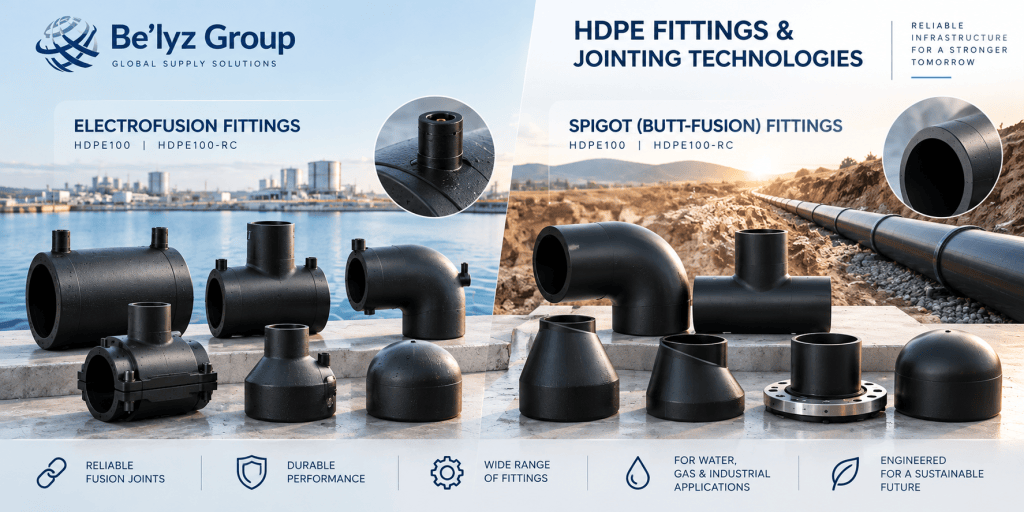
Engineered Connection Solutions for Reliable Polyethylene Pipeline Systems
Be’lyz Group supports the international supply of compatible PE100 and PE100-RC fittings, jointing components and pipeline connection solutions for water transmission, gas distribution, industrial infrastructure and irrigation projects.
Our sourcing portfolio includes butt-fusion fittings, electrofusion fittings, flanged connections and selected mechanical transition systems, subject to application-specific standards and verified supplier capabilities.
7.1. Butt-Fusion Fittings
Butt-fusion fittings are designed to create permanent welded connections between compatible polyethylene piping components.
Common product configurations include:
- Elbows: 30°, 45°, 60° and 90° configurations, subject to supplier availability.
- Equal Tees: Branch connections with matching nominal diameters.
- Reducing Tees: Branch connections between different pipe diameters.
- Reducers: Concentric or eccentric transitions, where available and suitable.
- End Caps: Components used to terminate polyethylene pipelines.
- Stub Ends: Polyethylene components used with compatible backing rings for flanged connections.
Fittings may be manufactured through moulding or approved fabrication methods. Fabricated fittings require particular attention to pressure derating, welding quality and applicable product standards.
7.2. Electrofusion Fittings
Electrofusion fittings incorporate embedded electrical resistance heating elements that allow compatible polyethylene components to be joined under controlled welding conditions.
Typical products include:
- Electrofusion couplers.
- Electrofusion elbows.
- Electrofusion tees.
- Electrofusion reducing fittings.
- Electrofusion tapping saddles.
- Electrofusion end caps.
Electrofusion systems are commonly used in pipeline installation, repairs, confined working areas and applications requiring controlled joint assembly.
Joining procedures must follow the fitting manufacturer’s approved instructions and applicable standards.
7.3. Flange Adaptors & Mechanical Connections
Flanged connections are used where polyethylene pipelines interface with valves, pumps, steel pipelines and industrial equipment.
Typical components include PE stub ends, backing rings, flange adaptors, gaskets and suitable bolting assemblies.
Mechanical transition fittings may also be used for connections between polyethylene and other piping materials.
Selection must consider pressure rating, flange dimensions, gasket compatibility, axial restraint requirements and service conditions.
7.4. HDPE Jointing Methods
The principal connection methods used in PE100 and PE100-RC piping systems include:
Butt Fusion
Compatible pipe ends are heated and joined under controlled temperature, pressure and alignment conditions.
Electrofusion
Compatible pipe and fitting surfaces are fused through controlled electrical heating elements integrated into the fitting.
Flanged Connections
Detachable mechanical connections using compatible flange components, gaskets and bolting systems.
Mechanical Couplings
Approved mechanical fittings used for selected transition, repair and connection applications.
Joint selection must be verified against the intended service, pipe dimensions, material compatibility, installation conditions and applicable technical approvals.
7.5. Technical Compatibility & Quality Requirements
Before procurement, the following parameters should be confirmed:
- Nominal outside diameter and SDR classification.
- PE100 or PE100-RC material compatibility.
- Intended service and operating conditions.
- Applicable product and fitting standards.
- Fitting pressure classification and any required derating.
- Approved joining procedures and equipment requirements.
- Product identification and traceability documentation.
- Inspection and testing requirements.
For gas distribution systems, fittings and joining methods must be specifically approved for the intended gas service.
7.6. Project-Specific Fitting Supply
Be’lyz Group coordinates the sourcing of compatible fitting packages according to customer drawings, bills of quantities, project specifications and confirmed supplier capabilities.
Our approach supports coordinated procurement of pipes, fittings and connection components, helping customers maintain dimensional compatibility, technical consistency and documented product traceability across the piping system.
8. Installation Methods & Engineering Considerations
Engineered Installation Solutions for Conventional and Demanding Pipeline Projects
PE100 and PE100-RC piping systems support a range of installation methods for water transmission, gas distribution, industrial infrastructure and underground utility networks.
Selection of the appropriate pipe configuration and installation technique depends on ground conditions, operating requirements, external loads, pipe dimensions and project-specific engineering assessments.
8.1. Conventional Open-Trench Installation
Open-trench installation is widely used for polyethylene pressure pipelines in municipal and industrial infrastructure.
Proper trench preparation, bedding, pipe positioning, sidefill and backfilling are essential to support long-term pipe performance.
Engineering considerations include:
- Trench width and installation depth.
- Bedding and surrounding soil characteristics.
- Compaction and backfill requirements.
- Traffic loads and external ground pressure.
- Pipe deflection and allowable deformation.
- Protection against sharp objects and localized point loads.
PE100-RC pipes may offer additional resistance to slow crack growth under demanding installation conditions. However, their use does not eliminate the need for an approved installation design.
8.2. Horizontal Directional Drilling (HDD)
Horizontal directional drilling enables the installation of pipelines beneath roads, rivers, railways and other obstacles without continuous open excavation.
PE100-RC pipes are particularly relevant for selected HDD projects because of their enhanced resistance to slow crack growth.
Key engineering parameters include:
- Maximum installation pulling force.
- Minimum allowable bending radius.
- Borehole geometry and ground conditions.
- Pipe wall thickness and SDR.
- Surface damage and abrasion exposure.
- Joint integrity during installation.
Type 1, Type 2 and Type 3 PE100-RC constructions may be evaluated according to the required mechanical protection and installation conditions.
8.3. Pipe Bursting & Pipeline Rehabilitation
Pipe bursting is a trenchless rehabilitation technique in which an existing pipeline is fractured or displaced while a replacement pipe is installed along the original alignment.
PE100-RC pipes may be selected for suitable projects involving localized mechanical stresses and challenging installation environments.
The design must consider pulling loads, existing pipeline material, surrounding utilities, ground displacement and the selected pipe construction.
Additional protective jackets may be considered where installation-related surface damage is a significant concern.
8.4. Ploughing & Reduced-Bedding Installation
Selected PE100-RC systems may be considered for engineered ploughing, narrow-trench and reduced-bedding installation methods.
These methods can reduce excavation requirements under suitable site conditions.
However, their suitability depends on the approved pipe system, soil characteristics, external loads, installation equipment and applicable technical guidance.
The enhanced slow crack growth resistance of PE100-RC does not automatically authorize installation without bedding or other protective measures.
8.5. Thermal Expansion & Pipe Movement
Polyethylene piping systems exhibit temperature-dependent dimensional changes and mechanical behavior.
Engineering design must consider thermal expansion and contraction, pipe restraint, anchor locations, bending requirements and operating temperature.
Above-ground installations may require additional assessment of UV exposure, pipe support spacing, thermal movement and mechanical protection.
8.6. Pressure Surge & Hydraulic Design
Pressure pipeline design must account for normal operating pressure, transient pressure events, pump operation and system shutdown conditions.
Relevant considerations include:
- Maximum operating pressure.
- Pressure surge and water hammer.
- Pipe SDR and material classification.
- Operating temperature.
- Design coefficient and service conditions.
- Joint and fitting pressure compatibility.
The selected pressure classification must comply with the applicable product standards and engineering requirements.
8.7. Installation Quality & Joint Inspection
Installation quality plays a critical role in the long-term performance of polyethylene piping systems.
Depending on the project, quality control activities may include:
- Verification of pipe and fitting identification.
- Inspection for transportation or installation damage.
- Review of butt-fusion and electrofusion welding records.
- Equipment calibration and operator qualification.
- Joint inspection and acceptance.
- Pipeline pressure testing and commissioning documentation.
Be’lyz Group supports the coordination of relevant product documentation, supplier technical information and project-specific quality requirements.
9. Product Compliance, Certification & Technical Documentation
Verified Product Documentation for International Infrastructure Projects
Be’lyz Group supports the sourcing of PE100 and PE100-RC pipes and fittings with project-specific technical documentation, material traceability and product conformity verification.
Our documentation approach is designed to help customers assess the suitability of supplied piping systems against the applicable standards, contractual specifications and destination-market requirements.
9.1. Product Standards & Certification Verification
Product conformity is evaluated according to the intended application, selected pipe construction and relevant technical requirements.
Applicable references may include:
- EN 12201 / ISO 4427: Polyethylene piping systems for water supply and applicable pressure drainage and sewerage applications.
- EN 1555 / ISO 4437: Polyethylene piping systems for gaseous fuel supply.
- DIN 8074 / DIN 8075: Dimensional and quality requirements for applicable polyethylene pipe products.
- DIN CERTCO: Product-specific certification under the relevant certification scheme, where required.
- PAS 1075: Withdrawn technical specification historically associated with PE100-RC Type 1, Type 2 and Type 3 construction classifications.
Certificate validity, manufacturer identification, covered dimensions, product types and applicable standards must be verified for the actual products offered.
9.2. Raw Material & Production Traceability Documentation
Depending on the approved project quality plan, the documentation package may include:
- Polyethylene compound identification and technical data sheets.
- Raw material batch and lot certificates.
- Incoming material verification and test records.
- Production date, line and shift identification.
- Material batch-change records.
- Dimensional inspection and sampling reports.
- Finished-product batch identification and marking records.
The objective is to establish a documented connection between incoming materials, production records and finished piping products.
9.3. Inspection, Testing & Quality Records
Project-specific quality documentation may include:
- Approved Inspection and Test Plans (ITP).
- Raw material verification reports.
- Melt mass-flow rate and density test results.
- Hydrostatic pressure resistance test reports.
- Slow crack growth resistance test documentation, where applicable.
- Dimensional and visual inspection records.
- Shift-based production and measurement reports.
- Final product inspection and acceptance records.
- Third-party inspection reports, where specified.
Test frequency, acceptance criteria and reporting requirements must be established according to the relevant standards and contractual specifications.
9.4. Drinking-Water Contact Compliance
For potable water applications, compliance with polyethylene pipe product standards does not automatically establish approval for contact with drinking water.
The required hygienic suitability documentation must be evaluated according to the destination country’s regulatory framework.
Depending on the market, this may involve applicable national approval schemes, material assessments and finished-product testing.
Be’lyz Group supports the coordination and review of relevant supplier documentation and product approvals.
9.5. Technical Documentation Before Shipment
Before shipment, the agreed project documentation package may be reviewed for completeness and consistency.
This review can include verification of product descriptions, dimensions, SDR classifications, material grades, certificates, inspection reports and traceability records.
Any outstanding documentation requirements should be resolved in accordance with the agreed quality plan and contractual acceptance procedure.
Our Quality Commitment
Be’lyz Group aims to provide customers with transparent product documentation, coordinated quality verification and reliable material traceability throughout the supply process.
Our objective is to support technically compliant, well-documented piping solutions for demanding international infrastructure projects.
10. Why Choose Be’lyz Group for HDPE Piping Solutions?
More Than Supply — Technical Confidence, Material Traceability and Project-Focused Solutions
Be’lyz Group supports international infrastructure projects through a coordinated approach to polyethylene pipe sourcing, quality verification, technical documentation and supply planning.
We focus on aligning product specifications with project requirements while maintaining transparency throughout the procurement and production process.
10.1. Quality Verification from Raw Material to Finished Pipe
Our project-specific quality assurance approach extends beyond conventional final-product inspection.
Depending on the agreed quality plan, we coordinate pre-production raw material verification, random in-process sampling, shift-based dimensional inspections and final product testing.
This approach supports consistent product quality and documented conformity throughout the production cycle.
10.2. End-to-End Material Traceability
We place particular emphasis on linking raw material batches to production records, inspection results and finished-product identification.
Where material batch changes occur during production, corresponding records are reviewed to support traceability across manufacturing stages.
This documented approach is particularly valuable for potable water infrastructure and other projects requiring comprehensive quality evidence.
10.3. Project-Specific Technical Compliance
Our sourcing solutions are developed around the technical requirements of each project, including applicable product standards, material grades, dimensional tolerances, SDR classifications and certification requirements.
Where specified, valid DIN CERTCO certificates, PE100-RC performance documentation and relevant product conformity records are reviewed against the actual supplied products.
10.4. Custom Product Marking & Private Label Solutions
Be’lyz Group supports project-specific pipe marking and private-label requirements, subject to minimum order quantities, supplier capabilities and technical approval.
Custom marking may include project identification, product specifications and other agreed information without replacing mandatory standard markings.
10.5. Optimized International Loading & Supply Coordination
We coordinate project-specific loading plans for truck and container shipments to improve cargo utilization and transportation efficiency.
Full truckload and full container load arrangements may be developed according to pipe dimensions, order quantities, loading calculations and applicable transportation requirements.
10.6. A Project-Focused Supply Partner
Be’lyz Group combines international sourcing capabilities with technical coordination, quality documentation and material traceability support.
Our objective is to provide customers with reliable, well-documented PE100 and PE100-RC piping solutions tailored to the requirements of each infrastructure project.